
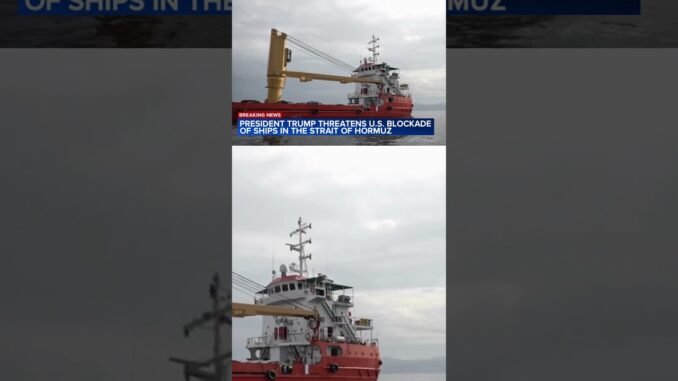

Summary: President Donald Trump issues stark warning to Iran as American forces establish naval blockade in Persian Gulf. Nigerian perspective on escalating US-Iran tensions and global implications.
The tension between the United States and Iran has reached a new boiling point, with President Donald Trump issuing what can only be described as a direct military threat to the Islamic Republic. In his latest statement, Trump warned that Iranian naval vessels approaching the US blockade zone will be “eliminated” – a word choice that leaves little room for diplomatic interpretation.
The Bold American Warning
Speaking with his characteristic bluntness, President Trump declared that Iran’s Navy has been “completely obliterated,” claiming 158 Iranian ships now lie at the bottom of the sea. While these figures require independent verification, the message is unmistakably clear: America is drawing a red line in the Persian Gulf, and they’re willing to back it up with military force.
For those of us watching from Nigeria, this development carries significant weight. As a nation that depends heavily on global oil markets and international trade routes, any major conflict in the Middle East – particularly one involving Iran, a major oil producer – could send shockwaves through our economy.
What This Means for the Global Stage
The establishment of a naval blockade represents one of the most aggressive moves one nation can make against another short of outright invasion. By blocking Iranian access to international waters, the United States is essentially attempting to strangle Iran’s economy and limit its military capabilities.
This isn’t just an American-Iranian matter. The Strait of Hormuz, which sits at the heart of this confrontation, is one of the world’s most critical chokepoints for oil transportation. Approximately one-fifth of global oil supplies pass through this narrow waterway. Any disruption here means higher fuel prices at Nigerian filling stations, increased transportation costs, and potential inflationary pressure on everyday goods.
The Nigerian Angle: Why We Should Pay Attention
Some might wonder why Nigerians should concern themselves with tensions thousands of kilometers away. The answer is simple: we live in an interconnected world, and nowhere is this more evident than in the global energy market.
Nigeria, as Africa’s largest oil producer, operates within a delicate global ecosystem. When tensions rise in the Middle East, oil prices typically spike. While this might seem beneficial for an oil-producing nation like ours, the reality is more complex. Higher global oil prices often come with economic instability, reduced international investment, and unpredictable market conditions – none of which favor long-term economic planning.
Moreover, many Nigerian businesses rely on imports that travel through potentially affected shipping routes. From electronics to machinery, from pharmaceuticals to food items, a significant portion of goods arriving at Lagos ports could face delays or increased costs if this conflict escalates.
The Diplomatic Fallout
What makes this situation particularly concerning is the apparent absence of diplomatic off-ramps. Trump’s language – speaking of elimination and obliteration – suggests a hardline approach that leaves little space for negotiation. This marks a stark departure from the careful diplomatic language typically employed in international relations, even during tense moments.
The international community now faces a critical question: How will other major powers respond? Will we see attempts at mediation from Europe, China, or regional powers? Or will nations be forced to choose sides in an escalating confrontation?
For Nigeria, which has historically maintained a non-aligned foreign policy stance, this presents both challenges and opportunities. Our diplomatic corps will need to navigate these treacherous waters carefully, protecting Nigerian interests while avoiding unnecessary entanglement in a conflict that serves neither our immediate nor long-term interests.
Economic Implications for the Average Nigerian
Let’s bring this home to the everyday reality of Nigerians. If this blockade leads to sustained conflict or even limited military engagement, we should prepare for:
– Rising fuel prices: Even with our local oil production, we import refined petroleum products. Global price increases will reflect at our pumps.
– Increased cost of goods: Everything from tomatoes to electronics could become more expensive as transportation and import costs rise.
– Exchange rate pressure: The naira could face additional stress as global economic uncertainty typically drives investors toward safer currencies.
– Potential supply disruptions: While unlikely to be severe, some imported goods might face delays.
The Path Forward
As this situation develops, Nigerians and the international community should hope for cooler heads to prevail. War benefits no one, and a sustained conflict in the Persian Gulf could trigger economic consequences that ripple across continents.
The question now is whether diplomatic channels can be reopened before this war of words becomes a shooting war. For Nigeria’s sake, and for the sake of global stability, one can only hope that wisdom will triumph over bravado.
As President Trump’s deadline approaches and American warships position themselves in the Gulf, the world watches and waits. The next move could determine whether we’re witnessing the prelude to conflict or merely another chapter in the long history of US-Iran tensions.
For now, Nigerians would be wise to stay informed, prepare for potential economic impacts, and hope that dialogue, not destruction, will ultimately carry the day.
—
What are your thoughts on this developing situation? How do you think it might affect Nigeria? Share your views in the comments below.
Get more info on buzzUp9ja
Be the first to comment