
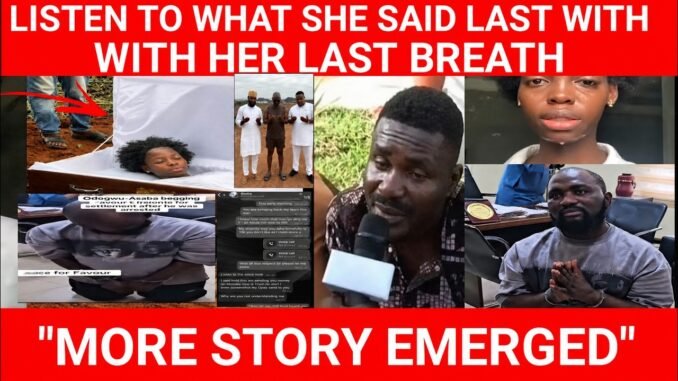

A 20-year-old woman is gone. Before she left, she made sure we heard her.
Favour Agbro was just 20 years old — full of life, with years ahead of her. But in a video that has since shaken the Nigerian internet to its core, she sat down, looked into the camera, and told her story. Not long after, she was gone.
In the video, Favour recounted how she met popular content creator Odogwu Asaba, and what she alleged happened between them — an encounter she described as rape. With a calm that was more devastating than any tears, she laid out her experience in detail before taking her own life.
The Video That Broke Nigeria’s Heart
The footage, which quickly went viral across Nigerian Twitter (now X), TikTok, and WhatsApp, shows a young woman who was not ranting, not seeking clout — but desperately seeking to be believed.
She spoke with clarity. She named names. She wanted accountability.
And then she was gone.
This Is Not Just a Story — It Is a Mirror
For many Nigerians, especially young women, Favour’s story is painfully familiar. The pattern is one we have seen too many times:
– A woman comes forward with allegations
– She is doubted, blamed, or silenced
– The accused — especially if he has followers, influence, or money — faces little to no consequence
– The victim is left to carry the trauma alone
We must ask ourselves the hard question: Did Nigeria fail Favour Agbro?
When a young woman feels that the only way anyone will listen to her is if she dies first — something is deeply, terribly wrong with our systems of justice, support, and accountability.
The Culture of Protecting “Big Men” Must End
Odogwu Asaba, like many Nigerian content creators, built a following on relatability and entertainment. But popularity is not a shield from accountability. Follower counts do not cancel out allegations of sexual violence.
Too often in this country, we rush to protect men with platforms while dismissing the women who accuse them. We ask “Why didn’t she report it?”* without asking *”Would reporting it have helped her?”
Nigeria’s legal system, social structures, and even our cultural narratives around rape often re-traumatise survivors rather than protect them. Many women already know this — and that knowledge is itself a death sentence for justice.
Mental Health, Rape Trauma, and the Silence We Keep
Favour’s death also forces us to confront the devastating state of mental health support in Nigeria.
Survivors of sexual violence need immediate, accessible, and stigma-free mental health care. They need safe spaces to speak. They need to know that someone — a counsellor, a hotline, a community — will catch them when they fall.
If you or someone you know is struggling, please reach out:
– NEEM Foundation Nigeria: 08062106493
– Mentally Aware Nigeria Initiative (MANI): Available via social media and their website
– Invictus Wellness Initiative: 09091892288
You are not alone. Your story deserves to be heard while you are still alive.
What Must Happen Now
Favour’s death must not become another trending topic that fades in 72 hours. Here is what needs to follow:
1. A thorough and transparent police investigation into the allegations against Odogwu Asaba
2. Justice for Favour’s family, who deserve answers and accountability
3. A national conversation about how Nigeria treats rape survivors
4. Pressure on content creator communities to take sexual violence allegations seriously
Rest, Favour
She was 20 years old. She had a name. She had a family. She had a future that was stolen from her — first by alleged violation, and then by a society that made her feel unheard.
We hear you now, Favour. We are so sorry it took this.
If you are a survivor of sexual violence in Nigeria, you can reach the WARIF Support Line at 08000333333 (free, 24/7). You deserve support. You deserve justice. You deserve to live.
Stay tuned for more updates on buzzUp9ja
Be the first to comment