
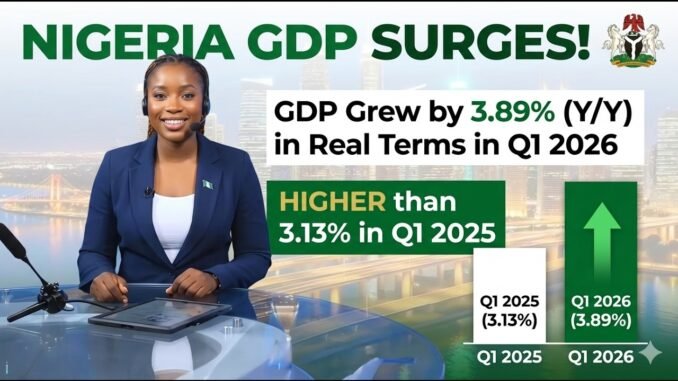

Summary: Nigeria’s GDP grew by 3.89% in Q1 2026 according to NBS data. Find out what’s driving this economic growth and how it affects everyday Nigerians.
The National Bureau of Statistics (NBS) has released encouraging news for Africa’s largest economy—Nigeria’s Gross Domestic Product (GDP) expanded by 3.89% year-on-year in real terms during the first quarter of 2026.
This latest economic report provides a fresh snapshot of how our nation is performing amid ongoing reforms and global economic uncertainties. But what does this growth figure really mean for the average Nigerian?
Breaking Down the Numbers
The 3.89% growth rate represents the pace at which Nigeria’s economy expanded compared to the same period last year. While this might sound like just another statistic from Abuja, it has real implications for jobs, investments, and the overall business climate across the country.
Economic analysts have been closely monitoring Nigeria’s growth trajectory, especially as the government continues implementing fiscal and monetary policies aimed at stabilizing the naira and controlling inflation. This Q1 performance will likely influence policy decisions in the coming months.
What’s Driving Our Economic Growth?
Nigeria’s economy remains heavily diversified, with key sectors including:
– Oil and Gas: Despite global energy transition talks, petroleum still plays a significant role in our economic performance
– Agriculture: The sector continues to be a major employer and contributor to GDP
– Services: From telecommunications to banking, the services sector remains vibrant
– Manufacturing: Growing interest in local production and reduced imports
The specific sectoral contributions to this Q1 growth will provide clearer insights into which parts of our economy are firing on all cylinders and which need more attention.
The Real Impact on Nigerians
For everyday Naija people, economic growth should theoretically translate into:
– More job opportunities across sectors
– Improved business conditions for SMEs
– Better infrastructure development
– Increased foreign investment
– Potential for improved living standards
However, many Nigerians know that GDP growth doesn’t always immediately reflect in their pockets. The distribution of economic gains remains a critical conversation in policy circles.
Looking Ahead
As we move deeper into 2026, economists and business owners will be watching several factors:
– Global oil price movements
– Foreign exchange stability
– Inflation rates
– Government policy implementation
– Security improvements in key economic zones
The Q1 figures provide a foundation, but sustaining and improving this growth rate will require consistent effort across public and private sectors.
What Experts Are Saying
While detailed sectoral analysis is still being digested by economists, the 3.89% growth rate suggests Nigeria’s economy is maintaining positive momentum. However, experts emphasize that achieving the government’s ambitious growth targets will require addressing structural challenges including infrastructure deficits, security concerns, and ease of doing business.
This story is developing. Stay tuned for more detailed analysis of the sectoral performance and what it means for different regions across Nigeria.
What are your thoughts on Nigeria’s economic performance? How has the business climate affected you or your community? Share your experiences in the comments below.
Get updated on buzzUp9ja
Be the first to comment