
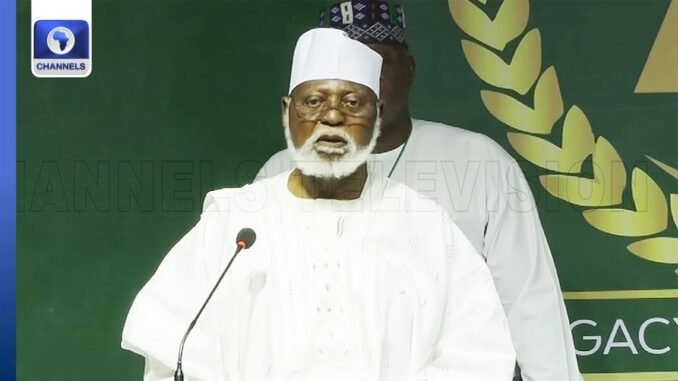

Summary: Former Head of State General Abdulsalami Abubakar reveals how he confronted General Sani Abacha about the dangerous clique of officers surrounding him and how they marked him for elimination.
In a stunning revelation that sheds new light on one of Nigeria’s most turbulent political eras, former Head of State General Abdulsalami Abubakar has disclosed how he boldly confronted the late General Sani Abacha about the dangerous coterie of officers wielding unhealthy influence over his regime.
General Abubakar, who eventually succeeded Abacha and midwifed Nigeria’s return to democratic rule in 1999, revealed that he personally advised the late military ruler to disband the notorious kitchen cabinet that had formed around him—a group of officers whose counsel was leading the country down a perilous path.
The Kitchen Cabinet That Nearly Cost Him His Life
According to the former military leader, this clique of officers didn’t take kindly to his honest advice. In what can only be described as a chilling episode in Nigeria’s political history, General Abubakar disclosed that these officers had actually marked him and several other senior military officials for elimination.
“I told him to disband that clique of officers around him who were a bad influence,” General Abubakar reportedly said, demonstrating the courage it took to speak truth to power during one of Nigeria’s most repressive military eras.
The Abacha years, spanning from 1993 to 1998, remain one of the darkest chapters in Nigerian history, characterized by human rights abuses, political repression, and the mysterious deaths of several prominent Nigerians, including Chief MKO Abiola, the presumed winner of the June 12, 1993 presidential election, and General Shehu Musa Yar’Adua.
A Regime Within a Regime
The existence of this powerful inner circle within Abacha’s government has long been the subject of speculation among political observers and historians. General Abubakar’s revelation confirms what many Nigerians suspected: that a small group of officers had essentially hijacked the machinery of state, making decisions that affected millions of Nigerians while shielding themselves from accountability.
This kitchen cabinet operated with impunity, and anyone who dared challenge their authority or question their methods—even senior military officers like Abubakar—risked being marked as an enemy of the state.
The Courage to Speak Truth to Power
General Abubakar’s willingness to confront Abacha about these officers demonstrates remarkable courage, especially considering the fate of others who had crossed the regime. His survival and eventual ascension to leadership after Abacha’s sudden death in June 1998 allowed him to steer Nigeria away from continued military dictatorship.
As Head of State for less than a year, General Abubakar fulfilled his promise to Nigerians by conducting elections that ushered in the Fourth Republic on May 29, 1999, with Olusegun Obasanjo as president.
Lessons for Contemporary Nigeria
This revelation comes at a time when Nigeria continues to grapple with questions about governance, accountability, and the danger of allowing unelected power brokers to wield disproportionate influence over those in authority.
The story serves as a powerful reminder of the importance of leaders surrounding themselves with honest advisers who prioritize national interest over personal gain—a lesson that remains relevant in Nigeria’s ongoing democratic journey.
General Abubakar’s disclosure adds another layer to our understanding of a critical period in Nigerian history and reminds us of the price patriots have paid to keep our nation together.
For more details, check buzzUp9ja
Be the first to comment