
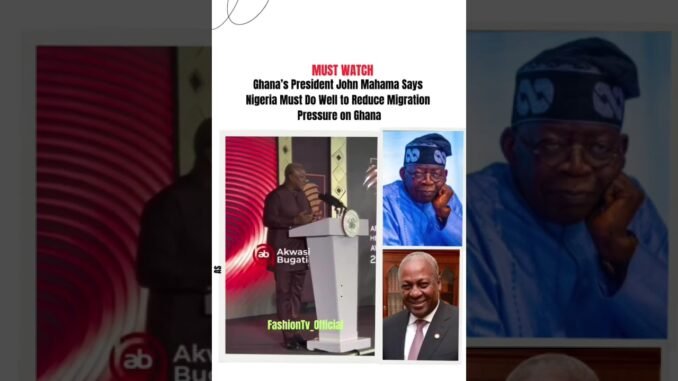

Ghana’s President John Mahama has sparked conversation across West Africa with candid remarks about Nigeria’s challenges and their potential regional impact
In a statement that has set tongues wagging across social media and policy circles, Ghanaian President John Mahama has expressed concern about Nigeria’s ongoing socio-economic challenges, revealing that he regularly prays for Africa’s most populous nation to overcome its difficulties.
The Ghanaian leader’s concern, however, isn’t just about neighbourly goodwill—it’s rooted in practical realities. President Mahama worries that if Nigeria’s situation continues to deteriorate, millions of Nigerians might seek refuge in Ghana, a scenario that could overwhelm his country’s resources and infrastructure.
A Brother’s Keeper or Self-Interest?
“I pray everyday for Nigeria to get their act together so that Nigerians don’t end up running to a small country like Ghana,” Mahama stated, highlighting the delicate balance between regional solidarity and national capacity.
The comment, while blunt, reflects a genuine concern shared by many West African leaders. Nigeria, with its population of over 200 million people, dwarfs Ghana’s roughly 33 million citizens. Any significant migration wave would fundamentally alter Ghana’s demographic and economic landscape.
The Japa Phenomenon Goes Regional
Mahama’s concerns come at a time when the “Japa” syndrome—the mass exodus of Nigerians seeking better opportunities abroad—has reached fever pitch. While most Nigerians traditionally set their sights on the UK, US, Canada, and other Western nations, deteriorating economic conditions at home have made even neighbouring African countries increasingly attractive destinations.
Ghana, with its relatively stable democracy, functional infrastructure, and growing economy, has become a popular alternative for Nigerians who cannot afford the expensive visa processes required for Western countries. From tech professionals to traders, healthcare workers to students, Nigerians have been quietly establishing themselves across various Ghanaian cities.
The Nigerian Diaspora in Ghana: A Double-Edged Sword
It’s worth noting that Nigerians already form a significant expatriate community in Ghana. Nigerian businesses, from restaurants to tech startups, dot the Ghanaian landscape, particularly in Accra. Nigerian entertainment, fashion, and culture have become deeply woven into Ghana’s social fabric—sometimes creating friendly rivalry, other times sparking tension.
While these Nigerian migrants bring entrepreneurial energy, investment, and skills that benefit Ghana’s economy, Mahama’s comments suggest there’s a tipping point beyond which the benefits might be outweighed by the strain on national resources.
What’s Driving Nigerians Away?
President Mahama’s prayer request inadvertently highlights the depth of Nigeria’s current challenges:
Economic Hardship: With inflation soaring above 30%, the removal of fuel subsidies, and the naira’s continued depreciation, many Nigerians are struggling to afford basic necessities.
Insecurity: From banditry in the North-West to separatist agitations in the South-East, and kidnapping across the nation, personal safety has become a luxury many Nigerians cannot guarantee.
Unemployment: Despite being Africa’s largest economy, Nigeria’s unemployment and underemployment rates remain stubbornly high, particularly among youth.
Infrastructure Deficit: Erratic power supply, poor road networks, and inadequate healthcare continue to frustrate citizens and businesses alike.
A Wake-Up Call for Nigerian Leaders
While some Nigerians on social media have taken offense at Mahama’s comments, viewing them as condescending, others see them as a much-needed wake-up call for Nigerian leadership. When your neighbour is praying you get your house in order—not out of pure altruism but because they’re worried about the overflow—perhaps it’s time for serious introspection.
The statement also raises important questions about Nigeria’s leadership and governance. If a country blessed with vast oil reserves, a massive young population, a vibrant entertainment industry, and entrepreneurial citizens cannot provide basic security and economic opportunities, what does that say about those in charge?
The ECOWAS Factor
Mahama’s concerns also touch on a broader West African reality. The ECOWAS protocol on free movement allows citizens of member states to live and work across the region without visa restrictions. While this promotes regional integration, it also means that severe crises in one country can quickly become regional problems.
Nigeria’s potential instability doesn’t just threaten Ghana—it could destabilize the entire West African region, from trade to security.
What Nigerians Are Saying
Reactions from Nigerians have been mixed. Some appreciate Mahama’s honesty, while others feel insulted by the characterization of their potential migration as a problem to be prayed against.
“Instead of being offended, we should ask ourselves why our neighbour is worried about us flooding their country,” one Twitter user observed. “That’s the real question we need to answer.”
Others have pointed out the irony: “We’re the giant of Africa but our people are looking to ‘small’ Ghana for greener pastures. Make it make sense.”
The Path Forward
President Mahama’s comments, uncomfortable as they may be for some Nigerians, shine a spotlight on urgent realities that cannot be ignored. Nigeria’s challenges are not just internal matters—they have regional and indeed continental implications.
For Nigeria to truly live up to its “Giant of Africa” moniker, leadership at all levels must prioritize good governance, security, economic reforms, and infrastructure development. The alternative—a continued exodus of Nigeria’s best and brightest, whether to Ghana, other African countries, or overseas—will only deepen the nation’s problems.
As for President Mahama, his prayers may need to be accompanied by practical diplomatic engagement. Nigeria’s success or failure will inevitably affect Ghana and the entire region. Perhaps rather than just praying, West African leaders should be collaborating on solutions that benefit everyone.
After all, in the words of an old African proverb: when your neighbour’s house is on fire, you don’t just pray—you also help put out the flames before they spread to your own home.
What do you think about President Mahama’s comments? Are they a necessary truth or an insult to Nigerian pride? Share your thoughts in the comments below.
Stay tuned for more details on buzzUp9ja
Be the first to comment