
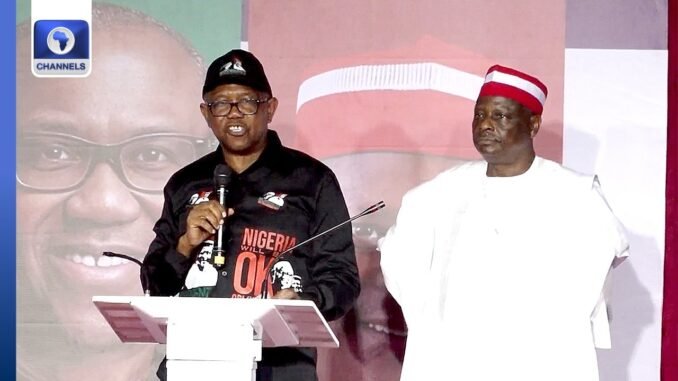

Former Anambra State Governor and presidential hopeful, Peter Obi, has made a bold declaration about his potential alliance with Rabiu Musa Kwankwaso, the New Nigeria Peoples Party (NNPP) leader, ahead of the 2027 elections. In a statement that has set political tongues wagging across the country, Obi emphasized that should their partnership materialize, Kwankwaso would be an “active partner” in governance, not a “spare tyre.”
Breaking Away from Nigeria’s Vice Presidential Tradition
For decades, Nigerians have watched Vice Presidents operate in the shadows of their principals, often reduced to ceremonial duties—cutting ribbons, attending funerals, and representing the President at events where his presence isn’t deemed critical. The office has become synonymous with political redundancy, earning nicknames like “spare tyre” among citizens who have grown cynical about the role’s lack of substance.
Peter Obi’s promise signals a potential departure from this tired tradition. Speaking to stakeholders, the Labour Party’s 2023 presidential candidate, who is now flying the flag of the Nigeria Democratic Congress (NDC), outlined his vision for a Vice Presidency that matters.
The Obi-Kwankwaso Alliance: A Match Made in Opposition Heaven?
The political courtship between Peter Obi and Rabiu Kwankwaso isn’t entirely new. Before the 2023 elections, there were intense negotiations between the Labour Party and NNPP camps about a possible merger. Those talks famously collapsed over the thorny issue of who would be the presidential candidate and who would settle for the number two spot.
Now, with 2027 on the horizon, it appears both political heavyweights are willing to give collaboration another shot. This time, Obi seems determined to sweeten the deal by promising real power-sharing arrangements.
“The Vice President in my government will not be a spare tyre,” Obi reportedly declared. “He will be an active partner in governance, with clear responsibilities and decision-making powers.”
What Would an “Active Partnership” Look Like?
While Obi didn’t spell out the specific responsibilities Kwankwaso would handle, political analysts are already speculating. Given Kwankwaso’s stronghold in the North—particularly Kano State where his Kwankwasiyya movement commands fierce loyalty—he would likely oversee critical northern development initiatives.
Some possibilities include:
– Northern Security Coordination: With banditry, kidnapping, and insurgency ravaging northern communities, Kwankwaso could lead a comprehensive security overhaul in the region.
– Agricultural Revolution: Given the North’s agricultural potential, the Vice President might champion food security programmes and support for farmers.
– Infrastructure Development: Kwankwaso’s track record as Kano State Governor showed his commitment to infrastructure. He could replicate this nationally.
– Political Bridge-Building: As a former PDP stalwart with deep connections across party lines, Kwankwaso would be invaluable in legislative negotiations and political consensus-building.
The Trust Factor: Can They Actually Work Together?
Nigerian politics is notoriously transactional and ego-driven. The question many are asking is whether Obi and Kwankwaso—two strong personalities with presidential ambitions—can genuinely work as partners rather than rivals within the same government.
Their failed merger attempt in 2023 exposed the challenges. Both men believed they were better suited to be the presidential candidate. Now, with Obi extending this olive branch, can Kwankwaso swallow his pride and accept the number two position, even with enhanced powers?
For ordinary Nigerians tired of the current administration’s performance, the answer matters less than the potential results. What citizens want is competent leadership that delivers on security, economic prosperity, and good governance—regardless of who sits where.
The Regional Mathematics
Let’s be frank: Nigerian politics still runs on regional and religious calculations, whether we like it or not. An Obi (South-East, Christian) and Kwankwaso (North-West, Muslim) ticket ticks important boxes that could reshape the electoral map.
The South-East has long felt marginalized in Nigeria’s power rotation. Obi represents their aspirations for national leadership. Meanwhile, Kwankwaso commands significant influence in the North-West, Nigeria’s most populous geopolitical zone. Together, they could present a formidable challenge to the ruling All Progressives Congress (APC) and the opposition Peoples Democratic Party (PDP).
Add the South-South and Middle Belt voters who supported Obi in 2023, and you have a potentially winning coalition—if they can hold it together.
Skepticism in the Air
Not everyone is convinced. Political observers remember the Labour Party’s internal crises after the 2023 elections, with different factions claiming leadership. They also recall how opposition parties in Nigeria have historically failed to unite against a common opponent, usually due to ego clashes and personal ambitions.
“We’ve heard these promises before,” said Chidi Okoro, a political analyst based in Abuja. “In 2023, we saw multiple opposition figures who couldn’t agree on a single candidate. What makes 2027 different? Nigerian politicians love power too much to genuinely share it.”
There’s also the question of Obi’s new political vehicle, the NDC. Launching or adopting a new party barely two years before the election comes with massive challenges: party structure, name recognition, nationwide reach, and the resources to compete with established parties.
What Nigerians Really Want
Beyond the political chess game, average Nigerians are focused on survival. With inflation at record levels, fuel prices that have tripled, insecurity that makes travel dangerous, and unemployment that leaves graduates hawking on the streets, citizens are desperate for change.
Whether that change comes from an Obi-Kwankwaso partnership, another opposition alliance, or even a reformed APC matters less than the actual delivery of democratic dividends.
The “not a spare tyre” promise sounds good on paper. But Nigerians have become expert at detecting political sweet talk. What they want are concrete plans: How will you fix the economy? What’s your security strategy? How will you generate and distribute electricity? What about education and healthcare?
The Road to 2027
With over two years until the next presidential election, much can change. Political alignments in Nigeria are notoriously fluid. Today’s partner might be tomorrow’s opponent. Today’s opposition might be tomorrow’s ruling party member.
However, Obi’s statement signals something important: the opposition is actively strategizing for 2027. Whether the Obi-Kwankwaso alliance becomes reality or remains political fantasy, it has already achieved one goal—keeping both men in the national conversation and reminding the current administration that 2027 is coming.
For Nigerian voters, the message is clear: start paying attention now. Ask questions, demand manifestos, scrutinize track records, and most importantly, get your PVC ready.
After all, in a democracy, the power ultimately rests not with political partnerships or party platforms, but with the people who cast the votes.
What do you think? Can Peter Obi and Rabiu Kwankwaso work together successfully? Would you support an Obi-Kwankwaso ticket in 2027? Share your thoughts in the comments below.
Check more updates on buzzUp9ja
Be the first to comment