
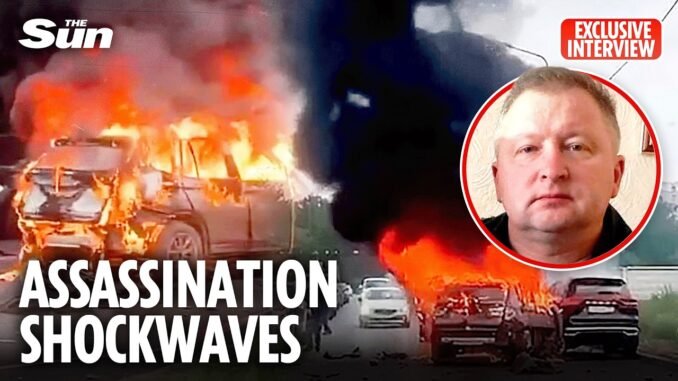

In a shocking security breach, a top Russian military commander lost his life in a targeted car bombing, allegedly after his own son unknowingly revealed critical information online
A senior Russian general has been assassinated in a devastating car bombing in Moscow, with intelligence reports suggesting that the deadly attack may have been made possible by an innocent social media post from his own son.
The high-profile killing, which sent shockwaves through Russia’s military establishment, highlights the dangerous intersection of social media carelessness and modern warfare—a lesson that resonates deeply in our increasingly connected world.
The Fatal Security Breach
According to multiple intelligence sources, the general’s son reportedly posted a photograph on social media that inadvertently displayed his father’s vehicle registration number. This seemingly harmless act of sharing may have provided enemy operatives with the exact information they needed to track and target the senior military official.
The explosion occurred in Moscow, marking yet another brazen attack on Russian soil targeting members of President Vladimir Putin’s inner military circle. The incident underscores the sophisticated surveillance and intelligence capabilities of those opposed to Russia’s military operations.
A Growing Pattern of Targeted Assassinations
This latest killing is part of a troubling trend of high-profile attacks on Russian military and intelligence officials since the beginning of the Ukraine conflict. Several generals, commanders, and key figures in Russia’s security apparatus have been eliminated in what appear to be carefully planned operations.
The use of social media intelligence to track and eliminate targets represents a modern evolution in warfare tactics—one that Nigerian security experts have also warned about in relation to our own military personnel.
The Social Media Danger Zone
For Nigerians, this incident serves as a stark reminder of the security risks associated with oversharing on social media platforms. Our own military and security personnel, as well as prominent public figures, face similar vulnerabilities when family members or associates post sensitive information online.
Security analysts in Nigeria have repeatedly cautioned against:
– Sharing vehicle registration numbers in photos
– Posting real-time location data of security personnel or their families
– Revealing residential addresses through geo-tagged content
– Displaying routine movement patterns that could be tracked
– Publishing information about security arrangements
Lessons for Nigeria’s Security Architecture
As Nigeria continues to battle various security challenges—from terrorism in the Northeast to banditry in the Northwest and kidnapping across multiple regions—this incident offers valuable lessons for our own security framework.
The Nigerian military has increasingly emphasized operational security (OPSEC) among troops and their families, particularly as insurgent groups demonstrate growing technological sophistication. This Moscow bombing reinforces why such measures are not mere bureaucratic procedures but potentially life-saving protocols.
The Digital Age of Warfare
Modern conflict has evolved far beyond conventional battlefields. Intelligence gathering now involves:
– Social media monitoring of targets and their associates
– Open-source intelligence (OSINT) compiled from publicly available information
– Digital forensics to establish patterns and vulnerabilities
– Cyber reconnaissance to identify and exploit security gaps
Nigerian security agencies have been working to upgrade their capabilities in these areas, recognizing that tomorrow’s battles will be fought as much in cyberspace as on physical terrain.
Protecting Our Own
For Nigerian families with members in the military, police, or other security services, this tragedy offers crucial guidance:
1. Limit social media exposure of security personnel and their movements
2. Avoid posting identifiable vehicle information
3. Be cautious with location tags and check-ins
4. Educate extended family about security protocols
5. Report suspicious online activity to appropriate authorities
The Broader Implications
This assassination also reflects the intense pressure on Russia’s military leadership as the Ukraine conflict continues. For Nigeria, which maintains diplomatic relations with both Russia and Ukraine, these developments are part of the complex international security landscape we must navigate carefully.
As we monitor global security events, the lessons learned can strengthen our own defenses against both external threats and internal security challenges.
Moving Forward
The tragic death of this Russian general serves as a sobering reminder that in our hyper-connected world, a single careless post can have deadly consequences. As Nigerians increasingly embrace digital platforms, we must balance our desire to share our lives with the imperative to protect those who protect us.
Security is everyone’s responsibility, and in the digital age, that responsibility extends to how we use our smartphones and social media accounts.
—
What are your thoughts on social media security? Have you taken steps to protect sensitive information about your family members online? Share your views in the comments below.
Get more details on buzzUp9ja
Be the first to comment