
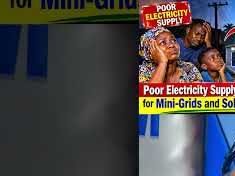

Summary: A Nigerian man has sparked an important conversation about the country’s persistent power crisis, arguing that reliable electricity is a government responsibility — not something citizens should have to solve themselves.
Let’s be honest — NEPA (we know, we know, it’s PHCN now, but old habits die hard) has been disappointing Nigerians for decades. From the classic “light is back!” celebration to the heartbreaking sound of a generator sputtering to life at 2am, Nigerians have arguably become the most creatively resilient people on earth when it comes to managing epileptic power supply.
But one man has decided he has had enough of normalising the abnormal — and his words are hitting differently.
—
“You Cannot Solar Panel Your Way Into Consistent Electricity”
A Nigerian man recently sparked a fiery conversation online after criticising the country’s persistent electricity crisis. His central argument? That access to reliable power supply is not a luxury — it is a basic responsibility of government — and no amount of personal hustle should substitute for that.
His point is simple but profound: Nigerians have been so conditioned to work around bad governance that we have started celebrating survival tactics as solutions.
Yes, solar panels are fantastic. Inverters are lifesavers. Generators have literally kept businesses, hospitals, and homes running. But at what cost?
—
The Real Cost of Nigeria’s Power Crisis
Let’s break it down. The average Nigerian household or small business owner spends a significant chunk of their income on:
– Petrol or diesel to power generators
– Inverter batteries that need regular replacement
– Solar panel installations that cost hundreds of thousands of naira upfront
– Constant repairs on power-related equipment
This is money that could go into savings, education, food, or business expansion. Instead, Nigerians are essentially running their own private power companies just to survive daily life.
A factory owner in Aba. A fashion designer in Lagos. A student in Enugu trying to charge a laptop to submit an assignment. A nursing mother in Kano keeping a fan running for her baby. They all share the same daily burden — and none of them signed up to be their own electricity provider.
—
“But At Least Solar Is Cleaner, Right?”
Of course, renewable energy is the future, and solar adoption in Nigeria is genuinely exciting. But there is a critical difference between choosing* clean energy as a progressive option and being *forced into it because the government has failed to provide basic infrastructure.
When a country like Germany transitions to solar, it is a choice* made from a position of already having reliable power. When a Nigerian family buys a solar setup, it is often an act of *desperation — a costly workaround to a problem that should have been solved at the national level decades ago.
That is the uncomfortable truth this man is pointing to.
—
This Is Not an Anti-Solar Argument — It Is a Pro-Accountability Argument
To be clear, nobody is saying throw away your solar panels or unplug your inverter. These tools have genuinely improved quality of life for millions of Nigerians, and that matters.
The real message here is about where we place responsibility.
When we say “just get solar,” we inadvertently let the government off the hook. We shift the burden from those in power — the people who collect taxes, manage national budgets, and sign electricity contracts — to ordinary Nigerians who are already overstretched.
Reliable electricity is not a privilege. It is infrastructure. And infrastructure is the government’s job.
—
What Needs to Change?
The conversation around Nigeria’s power sector needs to move beyond personal coping mechanisms and toward genuine systemic accountability:
– Transparent management of the electricity sector and distribution companies (DisCos)
– Investment in the national grid rather than patchwork solutions
– Consequences for underperformance by power sector stakeholders
– Citizen advocacy that demands more from elected officials
Nigeria has the population, the resources, and the talent to fix this. What has been missing — for far too long — is the political will.
—
The Bottom Line
The next time someone suggests you “just get a generator” or “just install solar” as a response to power failure, remember: those are coping strategies, not solutions.
You deserve consistent electricity. Your business deserves it. Your children doing homework at night deserve it. And no solar panel — however efficient — changes the fact that it should never have come to this in the first place.
The conversation has started. Now it is time to keep pushing.
What do you think? Is solar energy a real solution to Nigeria’s power crisis, or just an expensive workaround? Drop your thoughts in the comments.
For more information, check buzzUp9ja
Be the first to comment