
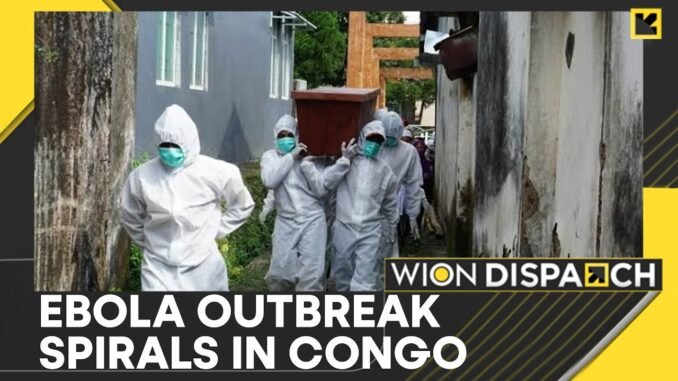

The Democratic Republic of Congo (DRC) is no stranger to Ebola. Since the virus was first discovered along the Ebola River back in 1976, the Central African nation has faced multiple outbreaks over the decades. But what is happening right now is something entirely different — and deeply alarming.
The current Ebola outbreak in the DRC has officially become the deadliest in the country’s history, with confirmed deaths surpassing the 2,300 mark, according to the latest official figures. Let that number sink in. Over two thousand lives — fathers, mothers, children, healthcare workers — wiped out by a virus that, with the right response, can be contained.
—
How Did We Get Here?
For those of us following the situation from Nigeria, it is easy to dismiss this as a “Congo problem.” But history has taught us better than that. We Nigerians know firsthand how quickly a single case can cross borders. Remember the Patrick Sawyer incident of 2014? One man stepped off a plane in Lagos, and suddenly, Nigeria was in the middle of an Ebola scare that shook the entire nation.
The DRC outbreak has been fuelled by a dangerous combination of factors:
– Ongoing armed conflict in the eastern regions, making it nearly impossible for health workers to reach affected communities
– Deep-rooted community mistrust of government and foreign medical teams
– Poor healthcare infrastructure that struggles to handle even routine illnesses
– High population movement across porous borders into neighbouring countries
These are not problems unique to Congo. Many of these challenges exist right here on our continent.
—
2,300 Deaths — And Counting
To put this figure in context, the previous deadliest outbreak on record was the 2014–2016 West Africa Ebola crisis, which claimed over 11,000 lives across Guinea, Sierra Leone, and Liberia. Nigeria, by God’s grace and swift action from our public health authorities, managed to contain its own exposure remarkably well during that period.
This current DRC outbreak, while still confined primarily within Congolese borders, has health experts genuinely worried. The death toll climbing past 2,300 is not just a statistic — it is a signal that the response, despite ongoing efforts, is struggling to get ahead of the virus.
—
What Nigeria and West Africa Should Be Doing Right Now
Our public health institutions — particularly the Nigeria Centre for Disease Control (NCDC) — must remain on high alert. Ebola does not need a visa to travel. Here is what proactive preparation looks like:
1. Strengthen border surveillance, especially at international airports and land borders
2. Scale up public awareness campaigns so Nigerians know the symptoms: sudden fever, severe headache, muscle pain, vomiting, and unexplained bleeding
3. Equip and train healthcare workers who are always the first line of defence
4. Maintain stockpiles of the Ebola vaccine (rVSV-ZEBOV), which has proven effective in previous outbreaks
The good news is that we have a vaccine. The tragedy is that getting it to the people who need it most — in conflict-ridden, hard-to-reach communities in eastern Congo — remains a massive logistical challenge.
—
The Human Cost We Must Not Ignore
Behind every statistic is a story. Over 2,300 Congolese families are grieving right now. Healthcare workers who showed up to save lives have themselves become victims. Children have been orphaned. Communities have been torn apart by both the disease and the fear that surrounds it.
As Africans, we owe it to each other to care. Nigeria, as the continent’s most populous nation and one of its strongest economies, has both the influence and the responsibility to advocate for stronger, better-funded responses to health crises like this — through bodies like the African Union* and the *Africa Centres for Disease Control and Prevention (Africa CDC).
—
The Bottom Line
The deadliest Ebola outbreak in DR Congo’s history is a wake-up call — not just for Congolese authorities, but for every African government and citizen. Disease does not respect borders, tribe, or social status.
We must continue to support strong public health systems, trust science and medical professionals, and hold our governments accountable for being prepared before the next crisis lands on our doorstep.
Because if 2014 taught us anything, it is this: when it comes to infectious disease outbreaks, no country on this continent is truly an island.
Stay informed. Stay safe. Follow updates from the NCDC and the World Health Organisation (WHO) for the latest guidance on Ebola and other disease outbreaks.
For more information, check buzzUp9ja
Be the first to comment