
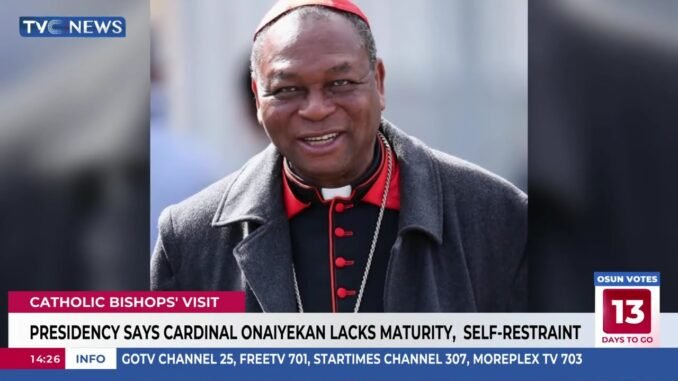

The Presidency has pushed back hard against Cardinal John Onaiyekan’s recent criticisms of President Bola Tinubu’s government, insisting the revered cleric was merely voicing his personal political leanings — not the collective voice of Nigerian Christians.
In what is shaping up to be one of the more charged exchanges between Aso Rock and the Nigerian clergy, the Presidency has drawn a clear line in the sand — Cardinal Onaiyekan’s sharp words against the Tinubu administration, they say, should not be mistaken for the position of the broader Christian community in Nigeria.
According to the Presidency, the Cardinal was not wearing his religious hat when he made those remarks. Instead, they claim he was speaking as someone with a political horse in the race — specifically, as a Catholic who openly supported Labour Party’s Peter Obi during the 2023 presidential election.
“Don’t Confuse Personal Politics With Religious Authority”
The message from the Presidency is blunt: Cardinal Onaiyekan’s criticisms are rooted in political disappointment, not spiritual discernment. In their view, the respected Catholic Archbishop Emeritus of Abuja was essentially speaking for a faction — Peter Obi supporters within the Catholic fold — rather than representing the tens of millions of Christians spread across Nigeria’s diverse denominations.
This is a significant distinction the Presidency wants Nigerians to hold onto firmly. Nigeria’s Christian community is not a monolith. From Pentecostals in Lagos to Anglican faithful in the East, and Baptist congregations across the North — Christians in Nigeria hold a wide spectrum of political views, and no single voice, however powerful, can claim to speak for all of them.
Why This Exchange Matters
Cardinal Onaiyekan is not just any critic. He is one of Nigeria’s most respected religious figures — a Prince of the Catholic Church whose words carry enormous weight across the country and beyond. When a man of his stature speaks, people listen. That is precisely why the Presidency felt the need to respond swiftly and directly.
For many Nigerians already feeling the pinch of current economic realities — from the biting effects of fuel subsidy removal to foreign exchange volatility — hearing a Cardinal voice frustrations with the government resonates deeply. The Presidency knows this, and their pushback is as much about managing public perception as it is about theological boundaries.
The Bigger Picture
This back-and-forth is a reminder of how deeply intertwined religion and politics remain in Nigeria. Religious leaders, whether they like it or not, often find themselves at the centre of political storms — their congregations hanging on every word, their endorsements capable of swaying millions.
The Presidency’s response also raises a fair question worth pondering: Where does pastoral concern end and partisan politics begin?
For now, that line remains blurry — and both sides appear unwilling to blink.
As Nigerians continue to navigate tough economic times, the conversation around accountability, governance, and who truly speaks for the people — whether from the pulpit or the podium — remains as relevant as ever.
Get more details on buzzUp9ja
Be the first to comment