
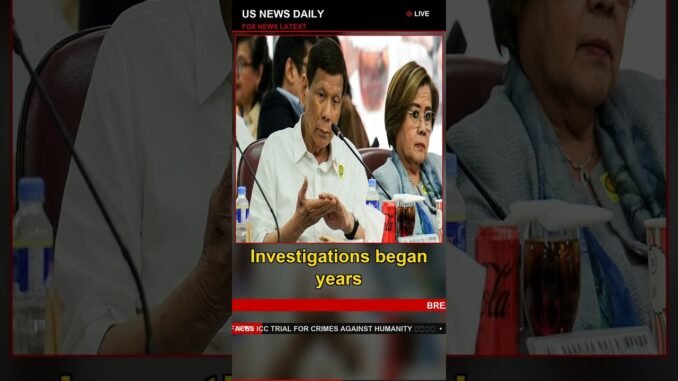

Summary: The International Criminal Court has unanimously confirmed charges against former Philippine President Rodrigo Duterte for crimes against humanity. Here’s what this historic decision means for global justice.**
In a landmark decision that has sent shockwaves across the international community, the International Criminal Court (ICC) has unanimously confirmed charges of crimes against humanity against former Philippine President Rodrigo Duterte. The ruling, delivered on Thursday by a three-judge panel, marks a significant milestone in the pursuit of accountability for alleged human rights violations during Duterte’s controversial presidency.
Understanding the Charges
The ICC’s decision to move forward with formal charges against Duterte represents one of the most high-profile cases in the court’s history. For many Nigerians familiar with our own complex political landscape and ongoing conversations about governance and human rights, this case serves as a powerful reminder that international justice mechanisms can reach even the highest offices of power.
The charges stem from Duterte’s infamous “war on drugs,” which critics say resulted in thousands of extrajudicial killings. During his six-year tenure from 2016 to 2022, human rights organizations documented widespread allegations of state-sanctioned violence, with estimates of deaths ranging from thousands to tens of thousands.
What This Means for Global Justice
This development is particularly significant for countries like Nigeria, where questions of accountability and justice remain pressing national concerns. The ICC’s willingness to prosecute a former head of state demonstrates that international law can serve as a check on executive power when domestic institutions fail to provide accountability.
Nigerian legal experts and human rights advocates have long debated the role of international justice mechanisms in addressing impunity. This case provides a concrete example of how the ICC operates when confronted with allegations of systematic human rights abuses.
The Road to The Hague
The journey to this point has been long and complex. The Philippines was a member of the ICC until 2019, when Duterte withdrew the country from the court—a move that came amid growing international scrutiny of his anti-drug campaign. However, the ICC maintains jurisdiction over alleged crimes committed while the Philippines was still a member state.
For many observers, particularly in Africa where the ICC has faced criticism for allegedly focusing disproportionately on African leaders, this prosecution of an Asian head of state may signal a more balanced approach to international justice.
Duterte’s Response and Defense
Throughout his presidency and even after leaving office, Duterte has remained defiant in the face of international criticism. He has consistently defended his anti-drug policies as necessary measures to combat a growing narcotics problem, claiming that the Philippines faced an existential threat from drug-related crime.
His supporters argue that his tough-on-crime approach resonated with many Filipinos who felt unsafe in their communities. This tension between public safety concerns and human rights protections is a debate that resonates in many developing nations, including Nigeria, where security challenges often spark discussions about appropriate government responses.
What Happens Next?
With charges now confirmed, Duterte will be required to stand trial at The Hague. The ICC will need to secure his transfer to the Netherlands, which could prove challenging. Unlike some international tribunals, the ICC has no police force and relies on member states to execute arrest warrants.
The Philippine government’s cooperation—or lack thereof—will be crucial. Current President Ferdinand Marcos Jr. has maintained that the Philippines will not cooperate with the ICC, citing the country’s withdrawal from the court. However, international pressure and diplomatic considerations may influence this stance over time.
Implications for Nigeria and Africa
For Nigerian readers, this case offers several important lessons:
1. International Accountability: The ICC’s action demonstrates that international justice mechanisms can function, albeit slowly, even when domestic accountability fails.
2. Sovereignty vs. Human Rights: The case highlights the ongoing tension between national sovereignty and international human rights obligations—a debate very much alive in Nigeria’s relationship with international bodies.
3. Documentation Matters: The success of the ICC’s case relied heavily on meticulous documentation by human rights organizations, journalists, and witnesses—emphasizing the importance of civil society watchdogs.
4. Political Will: The outcome will likely depend on sustained international pressure and political will, both globally and within the Philippines.
The Broader Context
This prosecution comes at a time when discussions about human rights, governance, and accountability are increasingly prominent across the globe. In Nigeria, as we grapple with our own security challenges and questions about appropriate state responses to crime and insurgency, the Duterte case provides a cautionary tale about the potential consequences of unchecked executive power.
The ICC’s decision also sends a message to current leaders worldwide: actions taken while in office may eventually face international scrutiny, regardless of domestic political support or constitutional protections.
Voices from the International Community
Human rights organizations have largely welcomed the ICC’s decision. Amnesty International and Human Rights Watch, both of which have documented alleged abuses during Duterte’s presidency, have called the ruling a “victory for victims” and a “step toward justice.”
However, critics of the ICC question whether the court selectively prosecutes leaders from smaller nations while avoiding cases involving powerful countries. This criticism, frequently voiced in African contexts, remains relevant to discussions about the legitimacy and effectiveness of international justice institutions.
Looking Forward
As this case proceeds, it will be closely watched not only in the Philippines and Southeast Asia but also in countries like Nigeria where questions of governance, human rights, and accountability remain central to political discourse.
The trial itself could take years, and numerous legal and political obstacles remain. Yet the confirmation of charges represents a significant step in a process that many victims’ families and human rights advocates feared might never materialize.
For Nigeria and other nations navigating the complex intersection of security concerns, governance challenges, and human rights obligations, the Duterte case will serve as an important reference point. It reminds us that while justice may be slow, it is not necessarily beyond reach—and that the international community, however imperfect its mechanisms, maintains tools for pursuing accountability when domestic avenues fail.
As we follow this historic case, we must also reflect on our own challenges and ask ourselves: How do we balance security needs with human rights protections? What accountability mechanisms do we need to strengthen? And how can we ensure that justice, both domestic and international, serves the interests of ordinary citizens rather than protecting the powerful?
The answers to these questions will shape not only how we judge Duterte’s legacy but also how we build more just and accountable societies across the globe.
—
This story will continue to develop as the ICC proceedings advance. Stay tuned on buzzUp9ja for updates on this landmark case and its implications for international justice.
Be the first to comment