
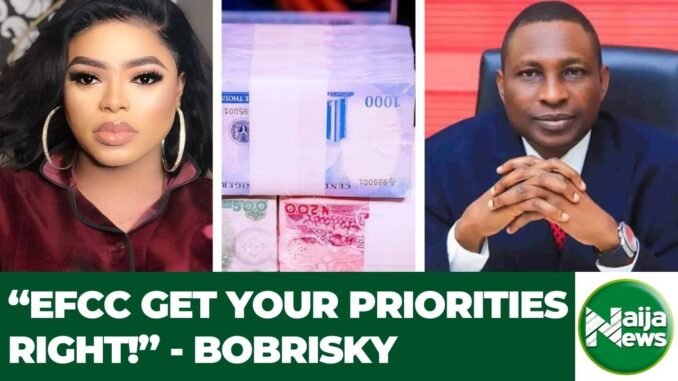

Summary: Popular crossdresser Bobrisky has taken a swipe at EFCC Chairman Olanikpekun Olukoyede for prioritizing the arrest of Nigerians spraying money at parties while bandits freely flaunt wealth on social media platforms.
Nigerian socialite and controversial crossdresser, Bobrisky, has gone hard on the Economic and Financial Crimes Commission (EFCC) and its chairman, Olanikpekun Olukoyede, accusing the anti-graft agency of misplaced priorities.
In a strongly-worded statement that has since gone viral on social media, Bobrisky questioned why the EFCC would focus its energy on arresting Nigerians who spray money at parties – a common cultural practice at Nigerian celebrations – while bandits and criminals openly display their ill-gotten wealth on platforms like TikTok without consequences.
The Naira Abuse Debate: Where Should EFCC Draw the Line?
The practice of spraying money at weddings, birthdays, and other social gatherings is deeply rooted in Nigerian culture. From Lagos to Kano, from Port Harcourt to Abuja, you’ll find guests expressing joy and appreciation by spraying crisp naira notes on celebrants and performers. It’s our way of celebrating, our way of showing love.
However, the EFCC has classified this age-old tradition as “naira abuse” and has been cracking down on offenders, sometimes making arrests at high-profile events. This enforcement has sparked widespread debate among Nigerians about whether the commission is focusing on the right issues.
“Many of You Will Rot in Hellfire” – Bobrisky Holds Nothing Back
Never one to mince words, Bobrisky didn’t hold back in his criticism of the EFCC boss. The socialite pointed out what many Nigerians have been saying quietly: while ordinary citizens are being hounded for spraying money at owambe, real criminals – including bandits who kidnap for ransom and terrorists who have destabilized entire communities – are living large and showcasing their wealth online without facing any consequences.
“You left bandits showing off money on TikTok to go after people spraying their own money in a party? Many of you will rot in hellfire,” Bobrisky declared, capturing the frustration many Nigerians feel about what they perceive as misplaced priorities by law enforcement agencies.
The Bigger Picture: Security vs. Naira Abuse
Bobrisky’s comments touch on a sensitive nerve in Nigerian society. While the EFCC’s mandate includes combating financial crimes and protecting the integrity of the naira, many citizens question whether arresting party-goers should take precedence over tracking down criminals who have genuinely destabilized the nation’s economy and security.
Bandits in the North-West and North-Central regions have collected billions of naira in ransoms. Kidnappers operate with seeming impunity. Yet, videos of some of these criminals flaunting money, motorcycles, and weapons on social media platforms continue to circulate without any visible action from authorities.
This contrast has led to growing public sentiment that law enforcement agencies are more comfortable going after “soft targets” – regular citizens at parties – rather than confronting the heavily armed criminals terrorizing communities across the country.
Social Media Reacts
As expected, Bobrisky’s statement has sparked massive reactions on Nigerian social media. While some users have criticized the socialite for the strongly-worded attack, many others have echoed similar sentiments, with the hashtag and comments pouring in across Twitter, Instagram, and Facebook.
“Bob actually said what we’ve all been thinking,” one Twitter user wrote. “How is spraying money at my sister’s wedding the same priority as bandits showing off millions on TikTok?”
Another added: “Make EFCC face the real criminals abeg. Na only party people them sabi catch.”
What the Law Says About Naira Abuse
For context, the Central Bank of Nigeria (CBN) Act prohibits the abuse of the naira, including spraying, squeezing, or writing on currency notes. Offenders can face six months imprisonment or a N50,000 fine, or both.
While this law exists on paper, its selective enforcement has become a source of frustration. Many Nigerians feel that if you must enforce this law, it should be done uniformly and not just at high-profile parties where celebrities and socialites gather, while ignoring more serious economic crimes.
The Real Question: Priorities in Law Enforcement
Bobrisky’s outburst, regardless of how you feel about the messenger, raises legitimate questions about priorities in Nigerian law enforcement:
– Should arresting party-goers for spraying money rank higher than tracking criminals who post evidence of their crimes online?
– Are our anti-corruption agencies equipped and willing to go after the “big fish” or are they more comfortable with easier targets?
– How can we balance cultural practices with respect for national symbols like our currency?
Final Thoughts
Whether you agree with Bobrisky’s delivery or not, the underlying message resonates with a growing number of Nigerians who want to see law enforcement agencies focus on the criminals genuinely threatening our national security and economy.
The EFCC has done commendable work in some areas, but public confidence depends on the perception that justice is blind and that enforcement is fair and proportionate to the offense.
As Nigeria continues to grapple with serious security challenges, perhaps it’s time for a national conversation about priorities – one that balances respect for our national symbols with the urgent need to address the more pressing threats facing our nation.
What do you think? Should the EFCC focus more on bandits flaunting wealth online or continue arresting Nigerians spraying money at parties? Drop your comments below.
Get more stories on buzzUp9ja
Be the first to comment