
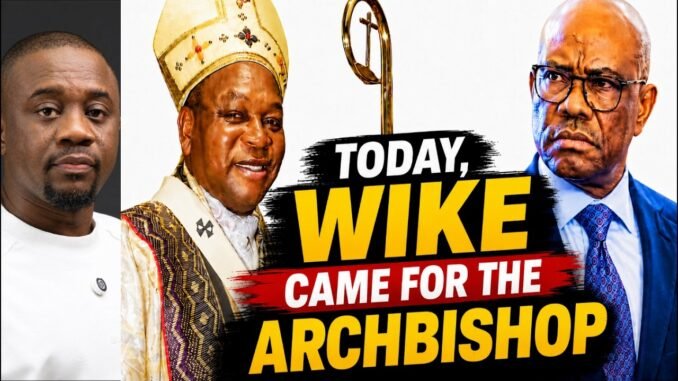

FCT Minister Nyesom Wike has thrown down the gauntlet, accusing Cardinal John Onaiyekan of playing partisan politics under the cover of religious authority.
The Minister of the Federal Capital Territory (FCT), Nyesom Wike, has openly challenged the neutrality of the Archbishop Emeritus of the Catholic Archdiocese of Abuja, Cardinal John Onaiyekan, alleging that the respected cleric’s recent criticisms of the Tinubu administration are anything but objective.
In characteristic Wike fashion — blunt, unapologetic, and straight to the jugular — the Rivers State-born politician suggested that Nigerians should not be deceived by the collar. According to him, the Cardinal’s public stance against President Bola Tinubu’s government is driven not by genuine pastoral concern for suffering Nigerians, but by political loyalty to a particular camp.
“We know who he is supporting,” Wike reportedly declared, leaving little to the imagination.
When the Pulpit Meets Politics
This latest drama is classic Nigeria — where the lines between faith, politics, and public commentary are perpetually blurred. Cardinal Onaiyekan has long been one of the Catholic Church’s most vocal figures on governance and social justice in Nigeria. From the era of military rule to the current democratic dispensation, the Cardinal has never been one to keep quiet when he believes the nation is headed in the wrong direction.
But Wike, never one to absorb a punch without throwing one back, is essentially telling Nigerians: “Look beyond the cassock.”
The Bigger Question Nigerians Are Asking
This back-and-forth raises a fundamental question that resonates deeply with everyday Nigerians: Can our religious leaders truly be neutral in a country as politically charged as ours?
From the mosque to the cathedral, Nigerians have long looked to their spiritual leaders for moral guidance — especially when government policies are biting hard. With the current economic realities — fuel prices through the roof, naira struggling, and the cost of living squeezing ordinary families — criticism of the administration from any quarter, including the church, is hardly surprising.
But Wike’s allegation, if true, would indeed raise uncomfortable questions about the integrity of such criticism.
Bottom Line
Whether you stand with Wike or with the Cardinal, one thing is clear — Nigerian politics spares nobody, not even men of God. And as long as the people continue to suffer, the conversation between the pulpit and the presidency will remain loud, messy, and very, very Nigerian.
What do you think? Should religious leaders speak out on government policies, or should they stay in their lane? Drop your thoughts in the comments.
For more details, check buzzUp9ja
Be the first to comment