
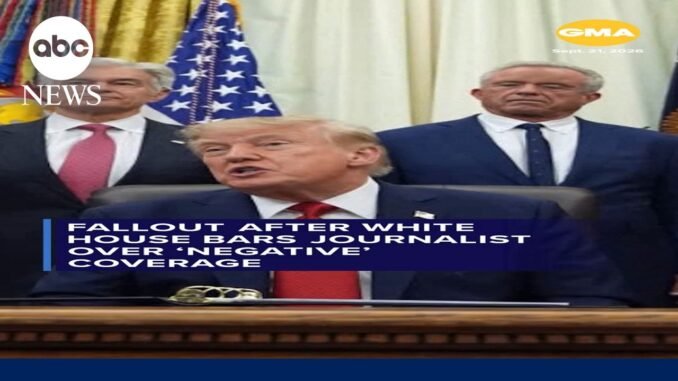

The Trump administration is doubling down on its decision to block major media outlets from White House access, with the Justice Department now backing the move by claiming these news organisations posed a threat to national security.
—
The United States Justice Department has thrown its full weight behind President Donald Trump’s controversial decision to bar CNN, MSNBC, and Politico from gaining access to the White House, insisting that such access is a privilege — not a right.
In a move that has sent shockwaves through global media circles, the DOJ argued that the banned news outlets had, in their view, threatened national security — a claim that critics and press freedom advocates have roundly dismissed as a dangerous overreach.
So, What Exactly Happened?
Trump’s administration took the bold step of restricting journalists from the three major news organisations from entering restricted presidential areas. The White House, under Trump, has long had a rocky relationship with what he famously calls the “fake news media,” but this latest development marks a significant escalation.
The Justice Department’s position is clear: access to the President and his inner circle is not guaranteed under the constitution. They argue that just as a private individual can choose who enters their home, the sitting President has the authority to determine who gets a seat at the table — or in this case, a press pass to the most powerful building in the world.
Why Should Nigerians Care About This?
You might be wondering — this is American politics, what does it have to do with us here in Nigeria?
Everything, actually.
Nigeria has had its own long and complicated history with press freedom. From the dark days of military rule when journalists like Dele Giwa were silenced in the most brutal fashion, to more recent clampdowns on media houses and social media restrictions, Nigerians understand better than most what it looks like when governments begin to chip away at the freedom of the press.
When the world’s most powerful democracy begins normalising the exclusion of journalists it considers unfriendly, it sets a dangerous global precedent. If America — a country that has long championed press freedom to the rest of the world — can justify banning CNN from a press briefing, what message does that send to governments in Abuja, Accra, or Harare that are already looking for excuses to muzzle critical voices?
The “National Security” Argument — A Familiar Playbook
Let us be honest: the phrase “national security” has been used by governments worldwide — including in Nigeria — to justify actions that often have very little to do with actual security concerns.
When the Buhari administration suspended Twitter in 2021, it also cited concerns about the platform being used to destabilise the country. The language is always similar: the press is a threat, the media is the enemy, information is dangerous.
The Justice Department’s invocation of national security to justify banning journalists is therefore not just an American problem — it is a page from a very familiar playbook that authoritarian-leaning governments across the world love to read from.
What Are Press Freedom Advocates Saying?
Unsurprisingly, organisations dedicated to protecting journalists have condemned the move. The argument from press freedom groups is straightforward: a free press is the cornerstone of any functioning democracy. When governments begin picking and choosing which journalists deserve access based on how favourable their coverage is, it fundamentally undermines the public’s right to unbiased information.
Critics also point out the chilling effect this kind of policy can have. If journalists know that asking hard questions or publishing unflattering stories could result in losing their White House credentials, many may begin to self-censor — and that, arguably, is even more damaging than an outright ban.
The Bigger Picture
At the heart of this issue is a question that affects every democracy on the planet: Who controls the narrative?
In a world where social media already allows politicians to speak directly to the public without any journalistic filter, the role of the independent press has never been more important — or more under threat.
For Nigerians who have watched this country’s own media landscape navigate political pressure, ownership interference, and outright intimidation, the events unfolding in Washington D.C. serve as a sobering reminder that press freedom is never truly guaranteed. It must be actively defended — whether in Aso Rock or the White House.
—
The battle for press freedom is a global one. What happens in America today can and does influence how governments around the world treat their own journalists tomorrow. Nigeria, take note.
Follow for more news on buzzUp9ja
Be the first to comment