
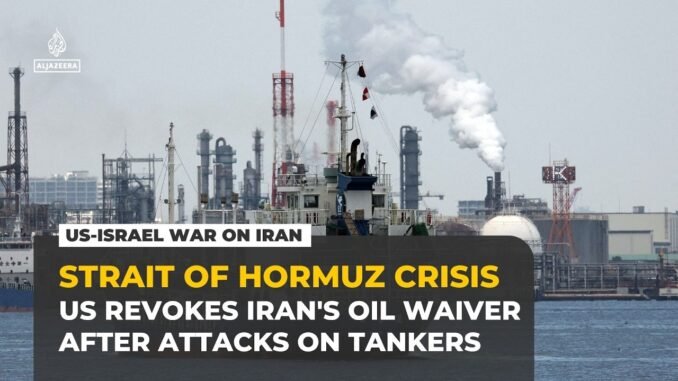

Summary: The United States has revoked Iran’s oil sanctions waiver following tanker attacks in the Strait of Hormuz. Here’s what this means for global oil markets and Nigeria’s economy.
The United States has pulled the plug on a temporary sanctions waiver it had granted Iran for oil exports, and the timing could not be more dramatic. The decision came on Tuesday, hot on the heels of targeted strikes on three oil tankers in the strategic Strait of Hormuz — one of the world’s most critical oil shipping routes.
This sharp policy reversal by Washington has sent shockwaves across global energy markets, and as a major oil-producing nation, Nigeria cannot afford to look away.
What Exactly Happened?
The US government had previously granted Iran a limited sanctions waiver, essentially giving certain countries a temporary pass to continue buying Iranian crude without facing American penalties. But following the tanker attacks in the Strait of Hormuz — a narrow waterway through which roughly 20% of the world’s oil supply passes — Washington decided enough was enough.
The Biden administration’s sudden about-turn signals a significant hardening of America’s stance towards Tehran, and analysts are already warning that the ripple effects will be felt from Wall Street to the oil fields of the Niger Delta.
Why the Strait of Hormuz Matters to Nigeria
For Nigerians wondering why a waterway thousands of kilometres away should concern us, here is the simple truth — global oil prices do not respect geography.
The Strait of Hormuz is essentially the jugular vein of international oil supply. Any disruption there — whether from military strikes, sanctions, or geopolitical tensions — sends crude prices climbing almost immediately. As a country whose economy still depends heavily on oil revenues, Nigeria stands to be directly impacted.
On one hand, rising global oil prices could mean more revenue for the Federation Account*, potentially easing some of the pressure on the naira and government spending. On the other hand, higher crude prices at the international level often translate to *more expensive petrol and diesel at home — something everyday Nigerians already know too well following the removal of the fuel subsidy.
The Bigger Geopolitical Picture
The revocation of Iran’s oil waiver is not happening in isolation. It is part of a broader US strategy to squeeze Tehran economically, cutting off the revenue streams that Washington accuses Iran of using to fund regional proxy conflicts across the Middle East.
For global oil markets, this means Iranian crude — which was already under heavy restrictions — becomes even more difficult to trade legally. Countries that were still purchasing Iranian oil under the waiver will now have to find alternative suppliers or risk facing US sanctions themselves.
This tightening of supply comes at a time when global energy markets are already navigating choppy waters, with OPEC+ production cuts and post-pandemic demand recovery keeping prices elevated.
What Nigerian Stakeholders Are Watching
Nigeria’s oil sector players, policymakers at the Nigerian National Petroleum Company Limited (NNPCL), and the Federal Government will be closely monitoring how this situation develops. Key questions include:
– Will OPEC respond? Nigeria, as an OPEC member, may be part of any coordinated response to fill the supply gap left by further Iranian restrictions.
– How will this affect the naira? Higher oil prices could boost Nigeria’s dollar earnings, providing some relief to the embattled local currency.
– What happens at the pump? Nigerians still dealing with the aftermath of subsidy removal will be watching fuel prices nervously.
The Bottom Line
The US revocation of Iran’s oil sanctions waiver is a bold geopolitical move with consequences that stretch far beyond Washington and Tehran. For Nigeria — a nation whose fortunes remain deeply tied to the price of crude — this development is worth watching closely.
As the situation in the Strait of Hormuz continues to unfold, one thing is certain: in the global oil market, what happens in the Gulf does not stay in the Gulf.
Stay with us for continued updates on how global energy developments are shaping Nigeria’s economy.
Check buzzUp9ja for more details
Be the first to comment