
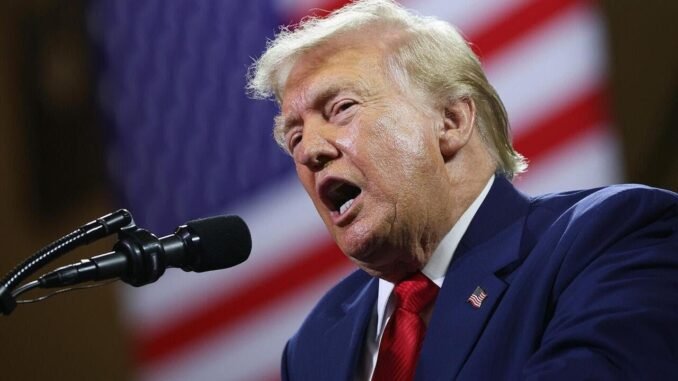

The United States House of Representatives has done something remarkable — they voted to put a leash on President Donald Trump’s ability to drag America into a full-blown war with Iran without first getting the green light from Congress.
Think of it like this: imagine the President of Nigeria deciding to send troops into a neighbouring country without the National Assembly’s approval. That kind of unchecked power is exactly what American lawmakers are pushing back against — and four members of Trump’s own Republican Party crossed the aisle to make it happen.
What Exactly Happened?
The House passed a resolution that would effectively block Trump from taking military action against Iran without explicit congressional authorisation. This is not just a political disagreement between party members — this is America’s lawmakers saying, loud and clear, “You cannot go to war alone.”
Four Republicans — yes, members of Trump’s own party — voted alongside the Democrats to pass the resolution. In a political climate where crossing your party leader can end your career faster than NEPA takes light, that takes serious courage.
Why Should Nigerians Care?
You might be asking yourself, “Wetin concern me with America and Iran?” — and that is a very fair question. But here is the truth:
Whatever happens between America and Iran affects all of us.
– Oil prices: Iran is a major oil producer. Any military escalation in the Middle East sends crude oil prices skyrocketing. For Nigeria, an oil-dependent economy still trying to recover from fuel subsidy removal, higher oil prices might sound good on paper — but the instability that follows is never good for business.
– Global security: Nigeria is already dealing with security challenges in the Northeast and across the Sahel. A destabilised Middle East creates ripple effects that fund extremist networks worldwide.
– The Naira and the economy: When global markets panic, Nigeria’s economy feels the tremors. We saw this during COVID-19, and we would see it again during any major international conflict.
The Bigger Picture — Checks and Balances Matter
What makes this story particularly interesting is the principle behind it. The US Constitution gives Congress — not the President alone — the power to declare war. Many Nigerians will relate to this struggle. We have our own ongoing conversations about the power of the executive versus the legislature, about who truly holds authority when it matters most.
Seeing American lawmakers stand up to their own president, regardless of party loyalty, is a reminder that democratic institutions exist for a reason — to prevent any one person from making catastrophic decisions on behalf of millions of people.
What Happens Next?
The resolution still faces an uphill battle. Even if it passes the Senate, Trump has the power to veto it — effectively rejecting it. And overriding a presidential veto requires a two-thirds majority in both chambers, which is a very tall order in today’s deeply divided American political landscape.
So while this vote is symbolically powerful, it may not immediately change what happens on the ground. But it sends a message — both to Trump and to the world — that not everyone in Washington is on board with an unchecked march toward war.
The Bottom Line
Democracy, whether in Abuja or Washington DC, is never a finished project. It requires constant vigilance, bold lawmakers, and citizens who pay attention. Today, a handful of American politicians reminded the world of that truth.
As Nigerians, we watch, we learn, and we ask ourselves — are our own institutions strong enough to do the same when it truly counts?
Stay informed. Share this story with someone who needs to understand why global politics is never far from home.
Check buzzUp9ja for more headlines
Be the first to comment