
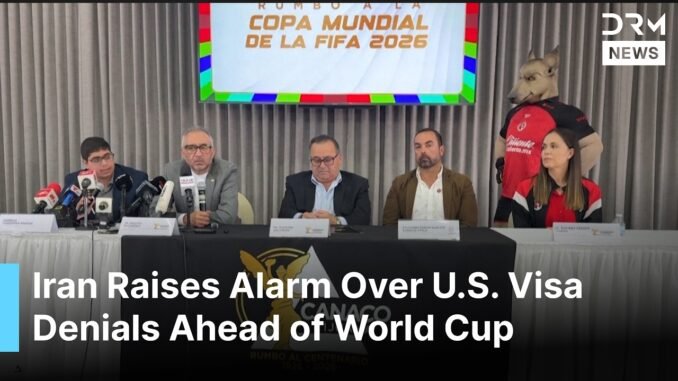

Summary: As the 2026 World Cup approaches, a diplomatic crisis unfolds as the United States refuses visa applications for several Iranian delegation members, raising questions about sports and politics mixing on football’s biggest stage.
The beautiful game is once again caught in the crossfire of international politics. With less than a week until the 2026 FIFA World Cup kicks off across North America, a major diplomatic wahala has emerged that threatens to overshadow the tournament’s opening festivities.
Multiple members of Iran’s official World Cup delegation have been denied entry visas to the United States, creating a last-minute crisis as the Iranian national team prepares to depart for Mexico. The visa denials have sparked heated exchanges between Tehran and Washington, reminding football fans worldwide that geopolitics often refuses to respect the boundaries of sport.
A Familiar Story of Politics and Football
For Nigerians who remember our own Super Eagles’ visa struggles over the years—from delayed American visas to European embassy wahala—this situation feels all too familiar. When politics enters the football pitch, it’s the players, officials, and fans who suffer most.
The 2026 World Cup, jointly hosted by the United States, Canada, and Mexico, represents the first expansion of the tournament to 48 teams. Iran qualified for the competition and was preparing to travel to their base in Mexico when news broke that several delegation members—reportedly including coaching staff, technical officials, and administrative personnel—had their U.S. visa applications rejected.
The Diplomatic Dimension
While specific details about which officials were denied entry remain unclear, the timing couldn’t be worse. Iran’s team is scheduled to depart for Mexico imminently, and the absence of key staff members could seriously disrupt their World Cup preparations.
The United States and Iran have maintained a complicated relationship for decades, with tensions escalating and cooling at various intervals. Sports events have historically provided rare moments of connection between the two nations—who can forget the memorable 1998 World Cup encounter in France when Iranian and American players exchanged flowers before their match?
However, this latest incident suggests that diplomatic relations remain frosty enough to impact one of the world’s most celebrated sporting events.
What This Means for the Tournament
FIFA has built its brand on the promise that football transcends borders, politics, and conflicts. The organization’s own regulations require host nations to provide visa guarantees for all participating delegations. These latest developments will test FIFA’s influence and its ability to ensure that all qualified teams can compete on equal footing.
For Iran, the visa denials create both practical and psychological challenges. Coaching staff and technical experts are crucial to any team’s World Cup campaign. Missing even one key analyst or trainer could impact match preparation, tactical planning, and player welfare throughout the tournament.
Nigerian Fans Watching Closely
Nigerian football supporters, who’ve experienced our own share of international travel drama, will be watching this situation with particular interest and sympathy. We know how frustrating it feels when bureaucracy and politics threaten to derail sporting dreams.
The Super Eagles didn’t qualify for the 2026 tournament, but Nigerians globally remain passionate World Cup viewers. Many will be wondering: if this can happen to Iran just days before the tournament, what precedent does it set for future competitions?
The Broader Questions
This incident raises uncomfortable questions about hosting major sporting events across multiple countries with different political alignments. While the tri-nation hosting arrangement was celebrated as innovative, it also creates unique diplomatic challenges.
Should countries with strained diplomatic relations be expected to co-host global tournaments? What responsibilities do host nations have to set aside political differences for the duration of sporting competitions? And most importantly, should athletes and support staff become collateral damage in geopolitical disputes?
What Happens Next?
As the World Cup’s opening ceremony approaches, all eyes will be on whether diplomatic channels can resolve this crisis. FIFA will likely be working behind the scenes with U.S. authorities to find a solution, though time is rapidly running out.
Iran’s football federation has not yet announced whether they’ll proceed with their travel plans to Mexico or how they’ll manage without the denied staff members. Some reports suggest they may seek to substitute other personnel, though replacing experienced technical staff on such short notice presents obvious challenges.
For now, football fans across Nigeria and around the world are left hoping that common sense and the spirit of sport will prevail—and that the 2026 World Cup will be remembered for brilliant football, not diplomatic disputes.
The beautiful game deserves better than to be held hostage by politics. Let’s hope the adults in the room find a solution before the opening whistle blows.
What do you think about visa issues affecting World Cup preparations? Should politics stay out of football entirely, or are some restrictions justified? Share your thoughts in the comments below.
Get more details on buzzUp9ja
Be the first to comment