
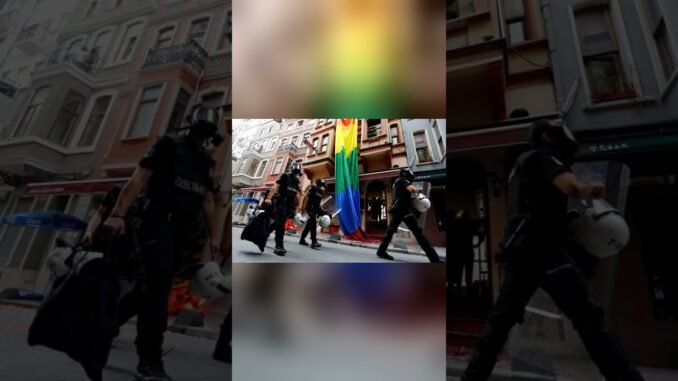

As Turkey intensifies its war against the LGBTQ+ community, rights groups are raising alarm over what they describe as a dangerous escalation of state-sponsored persecution.
Turkish authorities have swept across the country in a massive crackdown, arresting at least 162 people in coordinated raids targeting LGBTQ+ activists, organisations, and businesses. Police stormed gay bars, private homes, and community spaces in what human rights groups are calling one of the most aggressive anti-LGBTQ operations the country has seen in recent years.
Erdogan Points Fingers at LGBTQ Community Over Birth Rate Crisis
At the centre of the storm is President Recep Tayyip Erdogan, who has publicly blamed what he called LGBTQ “perverts” for Turkey’s rapidly declining birth rates. The strongman leader, who has long positioned himself as a defender of conservative Islamic values, used the country’s demographic challenges as fresh ammunition in his ongoing campaign against sexual minorities.
Turkey, like many countries, is grappling with a significant drop in birth rates — a complex economic and social issue that demographers and economists typically link to rising living costs, urbanisation, women’s increasing participation in the workforce, and shifting cultural attitudes. However, Erdogan has chosen a different villain entirely.
Raids Hit Homes, Bars, and Community Spaces
According to officials and rights organisations, the police operations were carried out across multiple cities, with officers raiding not just public venues but also private residences. Activists and community members were among those detained, sparking widespread condemnation from both local and international human rights bodies.
LGBTQ+ rights groups in Turkey have described the raids as a deliberate attempt to terrorise and silence an already vulnerable community. Several of those arrested were reportedly held for hours before being released, while others faced formal charges.
A Pattern of Persecution
This latest crackdown is not happening in isolation. Turkey’s relationship with its LGBTQ+ community has deteriorated sharply over the past decade. Istanbul’s once-vibrant Pride parade — which at its peak attracted tens of thousands of participants — has been banned since 2015, with authorities citing public order concerns. In recent years, anyone who attempts to march has faced rubber bullets, tear gas, and mass arrests.
Erdogan’s ruling AKP party has made opposition to LGBTQ+ rights a cornerstone of its cultural agenda, frequently invoking religion and traditional family values to justify discriminatory policies. Vice President Cevdet Yilmaz and other senior officials have echoed the president’s rhetoric, framing LGBTQ+ identities as a foreign import designed to undermine Turkish society.
International Community Reacts
Human rights organisations including Amnesty International and Human Rights Watch have condemned the arrests, calling on Turkish authorities to release all those detained and to end the criminalisation of LGBTQ+ identities. The European Union, which Turkey has long sought to join, has also expressed concern, with Brussels repeatedly flagging LGBTQ+ rights as a serious sticking point in accession talks.
For many observers, the timing of this crackdown — coming alongside Erdogan’s inflammatory rhetoric — suggests a calculated political move designed to rally his conservative base ahead of future elections.
Why This Matters Beyond Turkey’s Borders
For Nigerian readers, this story carries uncomfortable echoes. Nigeria remains one of the countries with some of the harshest legal penalties for homosexuality in the world, with the Same-Sex Marriage (Prohibition) Act of 2014 prescribing up to 14 years imprisonment, and Sharia law in northern states going even further. The rhetoric used by Erdogan — framing LGBTQ+ people as threats to family, religion, and national identity — mirrors arguments frequently deployed in Nigerian public and political discourse.
Whether one agrees or disagrees with the policies in question, what is happening in Turkey serves as a stark reminder of how quickly state power can be turned against minority groups when political leaders choose scapegoating over substantive policy solutions.
Turkey’s birth rate crisis will not be solved by arresting gay men and raiding bars. Economists and public health experts are clear on this. But for leaders who need a convenient enemy, the truth has rarely been the priority.
The situation in Turkey continues to develop. Rights organisations are urging anyone with information about those detained to contact relevant human rights bodies.
For more information, check buzzUp9ja
Be the first to comment