
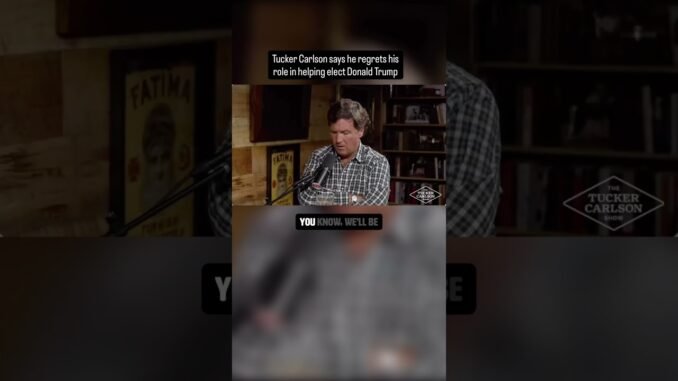

In a stunning admission that has sent shockwaves across American political circles, Tucker Carlson, the controversial right-wing commentator and former Fox News powerhouse, has openly apologized for his role in helping Donald Trump ascend to the U.S. presidency.
This revelation is particularly surprising for those who have followed Carlson’s career, as he was once considered one of Trump’s most vocal supporters in conservative media. The confession adds another dramatic chapter to the already turbulent relationship between media personalities and the former president.
From Champion to Critic
Carlson, who commanded one of the highest-rated shows on American cable news during Trump’s presidency, has become increasingly critical of the 45th U.S. president in recent years. His pivot from staunch supporter to vocal critic mirrors a broader split within conservative circles about Trump’s continued influence on Republican politics.
The admission of regret is significant not just for its content, but for its timing. As Trump positions himself for another presidential run, influential voices like Carlson’s carry considerable weight in shaping public opinion, particularly among conservative voters.
“I’ll Be Tormented”
Using particularly strong language, Carlson stated that he will be “tormented” for his role in Trump’s political success. This choice of words suggests a deep personal reckoning with the consequences of his media influence – a rare moment of public self-reflection from someone in his position.
For Nigerian observers of American politics, this development offers important lessons about the power and responsibility of media personalities in shaping political outcomes. Just as Nigerian media figures wield significant influence over public opinion and electoral politics, Carlson’s confession highlights how commentators can later grapple with the real-world impact of their advocacy.
The Power of Media Influence
Carlson’s admission raises critical questions about media responsibility that resonate far beyond America’s shores. In Nigeria, where media personalities and commentators similarly shape political discourse, this story serves as a cautionary tale about the long-term consequences of political advocacy.
The relationship between media figures and political leaders in Nigeria has always been complex, with journalists and commentators often walking a tightrope between reporting, advocacy, and influence. Carlson’s regret demonstrates that even in established democracies like the United States, these relationships can become sources of personal and professional conflict.
A Rare Public Apology
Public apologies from prominent media figures are uncommon, making Carlson’s statement all the more noteworthy. In an era where doubling down on controversial positions has become the norm, his willingness to express regret stands out.
This development also highlights the evolving nature of political allegiances. What seemed like an unshakeable alliance between Trump and conservative media has shown cracks, with figures like Carlson reassessing their earlier positions.
What This Means for American Politics
As the United States approaches another election cycle, Carlson’s change of heart could influence other conservative voices to distance themselves from Trump. However, it’s important to note that Trump’s base has historically remained loyal regardless of elite conservative opinion.
For Nigerians watching American politics – whether out of genuine interest, for business reasons, or because of family connections in the diaspora – this story illustrates the unpredictable nature of political coalitions and the potential for even the most committed supporters to experience buyer’s remorse.
Lessons for Nigerian Political Discourse
The Carlson confession offers several takeaways for Nigerian political observers:
1. Media accountability matters: Commentators and journalists should carefully consider the long-term implications of their political advocacy
2. Political relationships are fluid: Today’s staunch ally can become tomorrow’s critic
3. Public confession can be powerful: Admitting mistakes, even years later, can reshape public discourse
4. The burden of influence: Those with platforms carry responsibility for how they use them
The Road Ahead
Whether Carlson’s apology will impact his career or Trump’s political fortunes remains to be seen. What’s clear is that this admission has added fuel to ongoing debates about media responsibility, political influence, and the role of conservative commentators in shaping American democracy.
As Nigerians continue to navigate our own complex media and political landscape, stories like this remind us of the universal challenges facing democracies worldwide – the power of media, the consequences of political choices, and the courage it sometimes takes to admit when we’ve been wrong.
The question now is whether other prominent Trump supporters in media will follow Carlson’s lead, or whether his confession will remain an isolated incident in an increasingly polarized political environment.
Check buzzUp9ja for more updates
Be the first to comment