
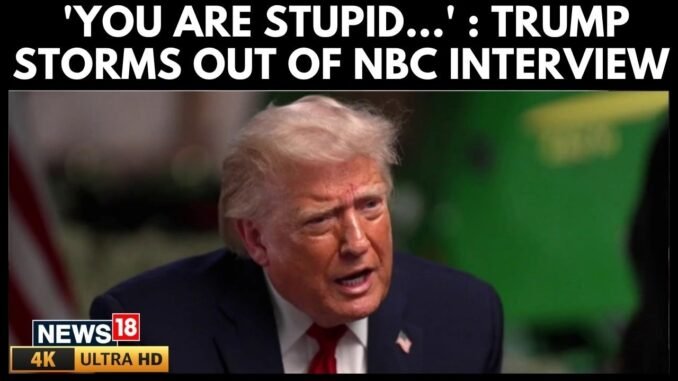

Summary: Donald Trump abruptly ended an NBC interview with Kristen Welker after confrontational questions about his election claims, pulling off his microphone and walking out while criticizing the media.
In a dramatic moment that has since gone viral across social media platforms, former United States President Donald Trump abruptly terminated an interview with NBC News after a tense exchange regarding his controversial election claims.
The incident, which was captured on camera, shows Trump growing increasingly agitated during his conversation with NBC correspondent Kristen Welker before making the decision to walk out of the interview entirely.
The Heated Exchange
According to reports, the interview took a contentious turn when Welker pressed Trump on his repeated assertions about the integrity of the 2020 presidential election—claims that have been widely disputed and rejected by election officials, courts, and fact-checkers across the United States.
As the questioning intensified, Trump’s frustration became evident. Witnesses say he launched into a familiar tirade against what he described as the “crooked, one-sided press,” accusing mainstream media outlets of bias against him and his political movement.
The Dramatic Exit
In a move that has become somewhat characteristic of his media interactions, Trump didn’t just end the conversation—he made a statement. The former president physically removed his microphone and walked away from the interview set, leaving Welker and the NBC crew behind.
This isn’t the first time Trump has clashed with journalists or walked out of interviews when faced with challenging questions. Throughout his presidency and afterward, he has maintained a combative relationship with several major news organizations, frequently dismissing critical coverage as “fake news.”
Nigerian Perspective: Media Relations and Leadership
For Nigerian observers familiar with our own political landscape, Trump’s behaviour raises interesting questions about how leaders should engage with the press. In Nigeria, where media freedom remains a critical issue and journalists often face significant challenges in holding power to account, the spectacle of a former world leader simply walking away from tough questions sends a complex message.
While some may view Trump’s exit as a stand against perceived media bias, others see it as an unwillingness to face accountability—a trait that should concern citizens everywhere, including here in Nigeria where transparency in governance remains an ongoing struggle.
Social Media Reaction
The video of Trump’s walkout quickly spread across Twitter, Instagram, Facebook, and other platforms, generating millions of views and thousands of comments. Nigerians on social media have joined the global conversation, with reactions ranging from amusement to concern about the state of political discourse in major democracies.
Some Nigerian Twitter users have drawn parallels between Trump’s media strategy and tactics employed by some politicians on the continent, noting that the desire to control narratives and avoid difficult questions transcends geography.
The Bigger Picture
This incident highlights the ongoing tension between Trump and mainstream media outlets—a relationship that has been fraught since his 2016 presidential campaign. His allegations of election fraud in 2020 continue to shape American political discourse, despite lacking substantial evidence and being rejected by numerous courts.
For international audiences, including Nigerians who follow American politics closely, these moments offer insights into the challenges facing democratic institutions when political figures refuse to accept electoral outcomes or engage constructively with journalistic scrutiny.
What This Means for Press Freedom
The confrontation serves as a reminder of the vital role that journalists play in democratic societies. Whether in America, Nigeria, or anywhere else, the press serves as a check on power—asking the difficult questions that citizens deserve answers to.
When leaders walk away from these questions, they walk away from accountability. And in an era where information spreads instantly across borders through social media, these moments of friction between power and press become global talking points that shape how we think about leadership and responsibility.
—
What do you think about Trump’s walkout? Should political leaders engage with all media questions, or do they have the right to walk away from interviews they consider unfair? Share your thoughts in the comments below.
For more information, check buzzUp9ja
Be the first to comment