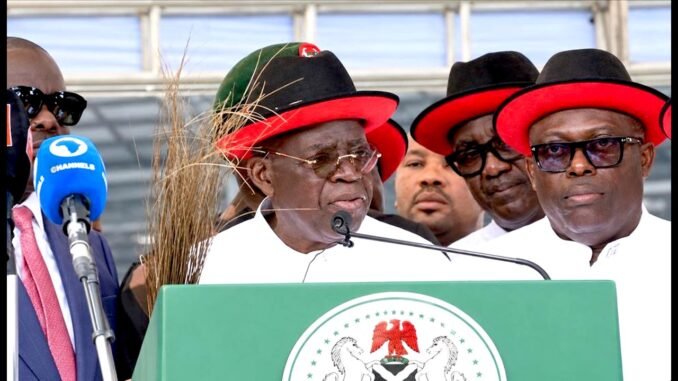

Summary: President Bola Tinubu has thrown down the gauntlet, challenging Nigerians to demand answers from former Vice President Atiku Abubakar about the source of funds used to establish his private university while serving as VP.
The political temperature in Nigeria just got several degrees hotter. President Bola Tinubu has gone on the offensive, calling on Nigerians to hold former Vice President Atiku Abubakar accountable by demanding to know exactly how he funded the establishment of his private university — all while serving as one of the country’s highest public officials.
The Challenge Has Been Thrown
In what many political watchers are describing as a classic counter-punch move, Tinubu did not mince words as he redirected scrutiny toward his long-time political rival. Rather than allowing Atiku to continue playing the role of opposition critic, the President essentially turned the table and told Nigerians: “If you want to ask questions, start there first.”
This kind of political chess is nothing new in Naija politics, but the directness of Tinubu’s challenge has set tongues wagging from Lagos Island to Maiduguri.
Why This Matters to Every Nigerian
For the average Nigerian hustling daily to make ends meet — from the trader in Onitsha Main Market to the civil servant in Abuja — questions around how public officials acquire wealth while in office are not just political gossip. They go to the heart of a fundamental problem: the blurry line between public service and private enrichment.
Atiku Abubakar, who served as Vice President under President Olusegun Obasanjo from 1999 to 2007, is the founder of American University of Nigeria (AUN) in Yola, Adamawa State. The institution, widely regarded as one of Nigeria’s premium private universities, reportedly cost billions of naira to establish. The question of how a sitting VP financed such a massive project has long been a topic of whispered conversation in political circles — and now, Tinubu has brought it to the front burner.
Pot Calling Kettle? Nigerians React
As expected, Nigerians on social media were not about to let this moment pass without sharp commentary. Many took to X (formerly Twitter) and Facebook to share their thoughts, with reactions split right down the middle.
Some Nigerians backed Tinubu’s call, arguing that it is a legitimate question that deserves a straight answer:
> “Atiku has never properly explained his wealth. This question has been there since forever.”
Others, however, were quick to apply the same standard right back to the President himself:
> “Oga Tinubu, the same question applies to you o. How did you build your own empire? Answer that one first before asking another person.”
This is very much a “who will bell the cat” situation, and Nigerians — sharp as ever — are refusing to let either side off the hook.
The Bigger Picture
Beyond the political back-and-forth, this exchange highlights a critical conversation that Nigeria desperately needs: transparency and accountability in public office.
Whether it is Tinubu, Atiku, or any other political figure, Nigerians deserve clear, verifiable answers about how public servants build massive private empires. The country’s anti-corruption framework, including the Code of Conduct Bureau and asset declaration requirements, exists precisely for this reason — yet enforcement remains a sore point for many citizens.
Bottom Line
Tinubu’s challenge to Nigerians to question Atiku’s university funding is a bold political move that has successfully shifted part of the public conversation. But in a country where citizens are increasingly politically aware and unwilling to give anyone a free pass, the President may well find that the same energy he is directing at Atiku could easily be redirected back at him.
As they say on the streets of Lagos — “E be like pot and kettle dey argue about who black pass.”
The real winners in all of this? Nigerian citizens — if, and only if, they demand accountability from all their leaders equally, without fear or favour.
What do you think? Should Atiku answer questions about his university funding? And should the same standard apply to all Nigerian politicians? Drop your thoughts in the comments below.
Get the full gist on buzzUp9ja
Be the first to comment