
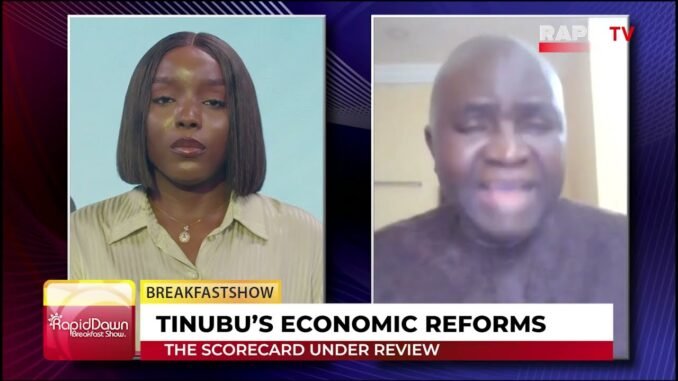

President Bola Tinubu has come out boldly to declare that the North is reaping the biggest rewards from his administration’s sweeping economic reforms — with the controversial removal of fuel subsidies sitting front and centre of his argument.
For many Nigerians, especially those in the North who have been bearing the brunt of rising fuel costs, food inflation, and general hardship, this claim might raise more than a few eyebrows. But let us break it down properly.
—
What Exactly Did Tinubu Say?
The President maintained that scrapping the fuel subsidy — that long-standing government arrangement that kept pump prices artificially low — was not just necessary, but ultimately a lifeline for Nigeria, particularly for the Northern region.
His position is that the old subsidy regime, rather than helping ordinary Nigerians, was largely enriching a small circle of powerful individuals and oil marketers — people who had turned the system into a personal egunje machine at the expense of the national treasury.
—
The Subsidy Debate: A Quick Refresher
For years, Nigeria spent hundreds of billions of naira annually maintaining fuel subsidies. On paper, it sounded like a pro-poor policy — cheaper petrol for the masses. In reality, many economists and policy analysts argued that the bulk of the benefit flowed to those with the means to own multiple cars, run generators, and access large volumes of fuel.
The North, being largely agrarian and with significant rural populations, was arguably not the biggest consumer of subsidised petrol in absolute terms. So Tinubu’s argument follows a logic — that redirecting those funds toward infrastructure, agriculture, and social investment could benefit regions like the North more directly.
—
But Here Is Where It Gets Complicated
While the theory sounds solid in a lecture hall or a policy brief, the reality on the ground in states like Kano, Sokoto, Maiduguri, and Zamfara tells a different story for now.
– Food prices have skyrocketed. Transportation costs, which are directly tied to fuel prices, have pushed up the cost of tomatoes, onions, rice, and virtually everything else.
– Small businesses are struggling. Petty traders and small-scale manufacturers who depend on fuel-powered generators are spending far more to keep their operations running.
– Poverty metrics remain concerning. The North already accounts for a disproportionate share of Nigeria’s poor, and the transition period of these reforms has been particularly painful.
—
The Government’s Counterargument
To be fair to the Tinubu administration, they have pointed to several interventions aimed at cushioning the impact, including:
– CNG bus rollouts to provide cheaper transportation alternatives
– Agricultural support programmes targeting Northern farming communities
– Social investment transfers to vulnerable households
The argument is essentially: yes, the pain is real, but it is temporary, and the long-term gains will be greater for those who were previously being shortchanged by a corrupt system.
—
What Nigerians Are Saying
Reactions, as you might expect, have been mixed. Some Northern leaders and governors have voiced support for the reforms, acknowledging that the subsidy era was unsustainable. Others, including opposition figures and civil society voices, insist that ordinary Northerners — the talakawa — are not yet seeing any tangible benefit.
The political undertone is also hard to ignore. With 2027 on the horizon, the President’s framing of the North as a key beneficiary of his policies is as much a political statement as it is an economic one.
—
The Bottom Line
Tinubu’s claim is not entirely without merit — at least in theory. If the savings from subsidy removal are genuinely channelled into development, food security, and infrastructure in underserved regions, the North could indeed emerge better off in the long run.
But theory and practice are two different things in Nigeria. The proof, as they say, will be in the pounded yam — or in this case, in whether the price of that pounded yam actually comes down for families across Kano, Kaduna, and Kebbi.
For now, Nigerians across the country — North, South, East, and West — are watching, waiting, and hoping that the promised gains of these reforms will eventually translate into real relief in their pockets.
—
What do you think? Is the North truly benefiting from Tinubu’s economic reforms, or is this political spin ahead of 2027? Drop your thoughts in the comments.
For more information, check buzzUp9ja
Be the first to comment