
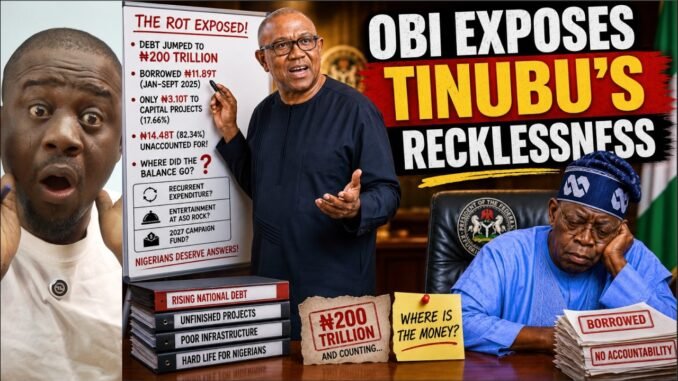

The former Anambra governor raises alarm over Nigeria’s escalating debt burden under the current administration
Peter Obi, the 2023 presidential candidate of the Labour Party, has raised serious concerns about the borrowing patterns of President Bola Ahmed Tinubu’s administration, claiming that the current government has accumulated more debt in just three years than former President Muhammadu Buhari did during his entire eight-year tenure.
Growing Debt Crisis
Speaking recently, the former Anambra State governor expressed alarm at what he described as Nigeria’s rapidly escalating debt profile under the Tinubu administration. This assertion comes at a time when many Nigerians are grappling with economic hardship, rising inflation, and concerns about the country’s fiscal sustainability.
Obi’s criticism touches on one of the most sensitive issues facing Africa’s largest economy – the question of whether increased borrowing is translating into tangible improvements in the lives of ordinary Nigerians.
Context: Nigeria’s Debt Journey
Under President Buhari’s administration (2015-2023), Nigeria’s debt grew significantly, rising from approximately $63 billion to over $103 billion by the end of his tenure. This trajectory already sparked debates among economists, civil society organizations, and opposition politicians about debt sustainability and productive utilization.
However, if Obi’s claims are accurate, it suggests an even more accelerated borrowing pace under the current administration, raising questions about the purposes, terms, and expected returns on these loans.
The Debate Over Borrowing
It’s important to note that borrowing itself is not inherently problematic for any government. Many developed nations maintain substantial debt portfolios. The critical questions are:
– What is the money being used for? Infrastructure development and productive investments can justify borrowing
– What are the terms? Interest rates and repayment schedules matter significantly
– What returns are being generated? Debt becomes problematic when it doesn’t produce economic growth
– Can we service the debt? The debt-to-GDP ratio and debt servicing costs are crucial indicators
Growing Economic Concerns
This debate comes against the backdrop of significant economic challenges facing everyday Nigerians:
– Removal of fuel subsidies leading to transportation cost increases
– Naira devaluation affecting purchasing power
– Rising food prices and inflation
– Increased cost of living across all sectors
– Growing unemployment and underemployment
Many Nigerians are questioning whether increased government borrowing is translating into improved infrastructure, better healthcare, quality education, or economic opportunities.
Political Implications
Obi’s statement also reflects the ongoing political discourse in Nigeria, where opposition voices continue to hold the government accountable for its economic policies. As someone who campaigned heavily on fiscal responsibility and productive governance during the 2023 elections, Obi has maintained his position as a vocal critic of policies he considers economically unsound.
The former governor built his political brand partly on his stewardship of Anambra State’s finances, often citing his record of leaving money in the state’s coffers rather than accumulating debt.
What Should Nigerians Watch?
As citizens, it’s essential to remain informed about:
1. Official debt figures from the Debt Management Office (DMO)
2. How borrowed funds are being utilized through project tracking
3. Economic growth indicators to assess if borrowing is yielding results
4. Government’s debt servicing ratio – how much of our revenue goes to paying debt
5. Alternative revenue generation efforts beyond borrowing
The Way Forward
Whether or not one agrees with Obi’s political stance, his statement highlights a conversation Nigeria must have seriously: how do we balance development financing needs with fiscal sustainability?
The government has a responsibility to be transparent about its borrowing, clearly communicate the purposes and expected outcomes, and ensure that borrowed funds translate into tangible benefits for the Nigerian people.
Similarly, Nigerians deserve leadership that prioritizes productive investments over consumption spending, that seeks to expand revenue through taxation reforms and economic diversification, and that demonstrates fiscal discipline in public expenditure.
Conclusion
As the debate over Nigeria’s debt profile continues, what remains clear is that economic management will be a defining issue for the Tinubu administration. The government’s ability to justify its borrowing through visible development, economic growth, and improved living standards for Nigerians will ultimately determine whether this debt accumulation is seen as necessary investment or fiscal recklessness.
For now, Peter Obi’s voice joins those of many concerned Nigerians asking the critical question: are we borrowing for tomorrow’s prosperity or today’s problems?
—
What are your thoughts on Nigeria’s borrowing levels? Do you see the benefits of government spending in your community? Share your perspective in the comments below.
More details? check buzzUp9ja
Be the first to comment