
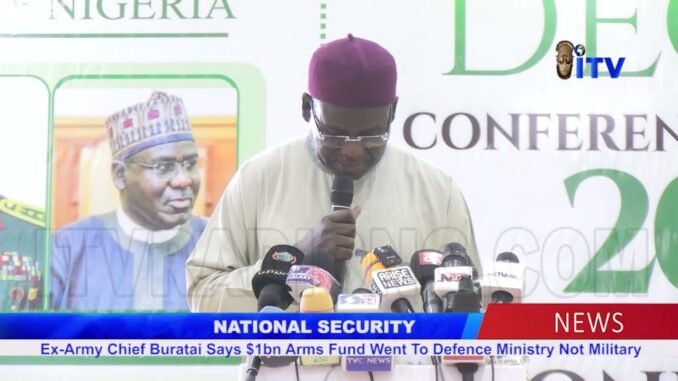

Former Chief of Army Staff Lt. Gen. Yusuf Buratai (retd.) has broken his silence on the controversial $1 billion arms procurement fund, making it clear that the money was released to the Federal Ministry of Defence — not directly to the Nigerian military.
If you have been following Nigerian news lately, you would know that the issue of defence funding has once again found its way into the national conversation. Now, one of the key figures at the centre of it all — former Chief of Army Staff, Lt. Gen. Yusuf Buratai (retd.) — has stepped forward to set the record straight.
What Exactly Did Buratai Say?
According to the retired general, the controversial $1 billion that was approved for defence procurement during his time as COAS did not* go directly into the hands of the military. Instead, he clarified that the funds were released to the *Federal Ministry of Defence, which is the appropriate civilian oversight body responsible for managing such allocations.
This distinction, though it may sound like a technicality to the average Nigerian on the street, is actually very significant. It speaks directly to questions of accountability, transparency, and the chain of command when it comes to how Nigeria spends its defence budget.
Why This Matters for Every Nigerian
Let’s be honest — when many Nigerians hear that $1 billion was approved for arms, the immediate question that comes to mind is: “Where did the money go? Did our soldiers actually get the equipment they needed?”
These are fair questions. For years, Nigerians have watched brave soldiers battle Boko Haram in the Northeast, bandits in the Northwest, and various security threats across the country — sometimes under very difficult conditions. Reports of poorly equipped troops have never been far from the headlines.
So when a fund of this magnitude is discussed, Nigerians deserve clarity. And that is precisely what Buratai is attempting to provide.
The Bigger Picture: Civilian vs. Military Control of Defence Funds
Buratai’s clarification also touches on a broader constitutional principle — civilian control of the military. In Nigeria’s democratic framework, the Ministry of Defence serves as the civilian interface between the government and the armed forces. Funds meant for defence procurement are typically routed through this ministry before reaching the military.
This structure is meant to ensure checks and balances. However, it also means that when things go wrong — when soldiers lack equipment or procurement scandals erupt — the question of who bears responsibility becomes complicated.
Nigerians Are Watching
The defence sector has long been a flashpoint for allegations of corruption and mismanagement in Nigeria. From the infamous arms procurement scandals of previous administrations to ongoing questions about military welfare, public trust in how defence funds are managed remains fragile.
Buratai’s public clarification suggests that this conversation is far from over. Whether his statement will lead to greater scrutiny of how the $1 billion was eventually utilised — and whether it translated into real, tangible improvements for Nigerian troops — remains to be seen.
One thing is certain: Nigerians will keep asking questions, and rightly so.
Stay with us for updates as this story develops. Drop your thoughts in the comments — do you think Nigeria’s defence procurement process needs more transparency?
Explore more options on buzzUp9ja
Be the first to comment