
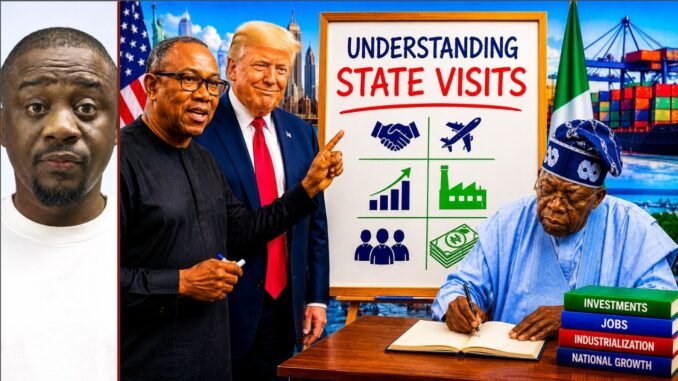

Former presidential candidate and Labour Party stalwart, Peter Obi, has once again sparked national conversation by questioning the effectiveness of President Bola Ahmed Tinubu’s numerous foreign trips. The vocal opposition figure insists that state visits by national leaders should be judged by their tangible economic outcomes, not the optics of international diplomacy.
The Core of Obi’s Criticism
Speaking to concerns shared by many Nigerians, Peter Obi drew a sharp contrast between President Tinubu’s recent state visit to the United Kingdom and former United States President Donald Trump’s highly strategic trip to China during his tenure. According to Obi, the difference lies not in the destination but in the deliverables.
“State visits by leaders are not tourism,” Obi stated emphatically, highlighting what he sees as a fundamental misunderstanding of the purpose of presidential foreign engagements. For the former Anambra State governor, every trip abroad by Nigeria’s number one citizen should return measurable economic benefits that justify the expense and effort.
Trump’s China Visit: A Case Study in Results
Obi pointed to Trump’s visit to China as an exemplary model of how state visits should function. During that trip, Trump secured concrete business deals, trade agreements, and investment commitments worth billions of dollars for the American economy. The visit wasn’t about photo opportunities or diplomatic pleasantries—it was a business mission with clear objectives and verifiable outcomes.
This comparison resonates with many Nigerians who have watched their president embark on multiple international trips since assuming office in May 2023, often with large delegations but seemingly limited concrete results to show the suffering masses back home.
The Cost of Presidential Travels
For ordinary Nigerians grappling with skyrocketing inflation, fuel subsidy removal, naira devaluation, and general economic hardship, the optics of frequent presidential trips abroad can be particularly frustrating. Each state visit comes with substantial costs—flight expenses, accommodation for large delegations, security details, and associated logistics.
The question many citizens are asking is simple: “Wetin we gain?” (What have we gained?)
Obi’s criticism taps into this widespread sentiment. In a country where pensioners struggle to receive their entitlements and workers battle to survive on minimum wage, every naira spent on state functions is scrutinized with increasing intensity.
What Should State Visits Achieve?
According to Peter Obi’s framework, successful state visits should deliver:
1. Investment Commitments: Concrete pledges from foreign governments or corporations to invest in Nigerian infrastructure, industries, or sectors.
2. Trade Agreements: Bilateral or multilateral trade deals that open new markets for Nigerian products or reduce barriers to export.
3. Technology Transfer: Partnerships that bring advanced technology, expertise, or know-how to Nigeria, particularly in critical sectors like agriculture, manufacturing, and renewable energy.
4. Job Creation: Deals that directly or indirectly create employment opportunities for Nigerian youth and professionals.
5. Debt Relief or Financial Support: Negotiations that result in favorable loan terms, debt forgiveness, or development assistance.
The UK Visit Under Scrutiny
While President Tinubu’s visit to the United Kingdom included meetings with British officials and members of the Nigerian diaspora community, critics like Obi argue that the trip lacked the kind of headline-grabbing economic wins that would justify its cost and the president’s time away from pressing domestic challenges.
Nigeria currently faces a perfect storm of economic difficulties—from insecurity in multiple regions to an energy crisis, unemployment, and a struggling naira. Many Nigerians believe their president’s attention should be laser-focused on these home-front challenges rather than frequent international engagements.
The Counterargument: Diplomacy Takes Time
Supporters of President Tinubu argue that international diplomacy is a long game. The benefits of state visits, they contend, may not be immediately visible but can materialize over months or years in the form of improved bilateral relations, smoother trade processes, or enhanced Nigeria’s international standing.
They also point out that maintaining Nigeria’s presence on the global stage is essential for a country of its size and influence in Africa. Isolation, they warn, would be far more costly than engagement.
A Pattern or an Exception?
Obi’s criticism gains weight when viewed against the backdrop of Nigeria’s recent presidential history. Previous administrations have also faced similar accusations of “presidential tourism” with limited economic returns. The challenge for any Nigerian leader is to break this pattern and demonstrate that foreign engagements translate into prosperity at home.
What Nigerians Want to See
The average Nigerian doesn’t oppose presidential foreign trips per se. What they demand is value for money and tangible benefits. They want to see:
– Factories opening as a result of foreign investments secured during trips
– Nigerian products gaining access to new markets
– Foreign companies setting up operations and employing Nigerians
– Infrastructure projects funded by international partnerships
– Skills and technology flowing into the country
When these outcomes are absent or unclear, skepticism naturally grows.
The Way Forward
Peter Obi’s intervention serves as a reminder to the Tinubu administration that Nigerians are watching, calculating, and demanding accountability. In an era of social media and instant information, the days of unquestioned presidential globe-trotting are over.
For President Tinubu, the solution may lie in greater transparency about the objectives and outcomes of foreign trips. Publishing detailed reports on what was achieved, what commitments were secured, and how these will benefit ordinary Nigerians would go a long way in addressing public skepticism.
Additionally, ensuring that presidential delegations are lean and purposeful—rather than bloated with officials and hangers-on—would demonstrate fiscal responsibility and seriousness of purpose.
Conclusion
As Nigeria continues to navigate challenging economic waters, the debate over presidential foreign trips will likely intensify. Peter Obi’s comparison between Trump’s China visit and Tinubu’s UK trip has touched a nerve because it addresses a fundamental question about leadership priorities and effectiveness.
State visits, as Obi rightly notes, are not tourism. They are high-stakes diplomatic and economic missions that should return dividends to the nation. Whether President Tinubu’s administration can demonstrate this value in its future engagements remains to be seen, but one thing is certain—Nigerians are keeping score.
The ball is now in the presidency’s court to prove that Nigeria’s international engagements are investments, not expenses; strategic moves, not mere photo opportunities.
Check for more updates on buzzUp9ja
Be the first to comment