
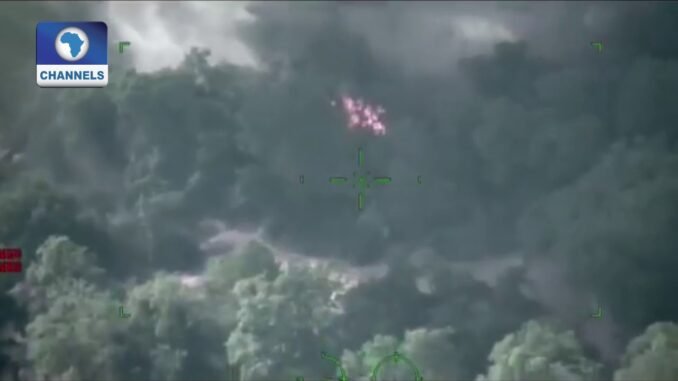

Summary: Nigeria’s Defence Minister, General Christopher Musa (retd.), reveals why rescue operations in Sambisa Forest remain a massive challenge — the forest is as large as the entire country of Belgium.
If you have ever wondered why it takes so long for security forces to rescue Nigerians kidnapped by Boko Haram and other terrorist groups operating in the North-East, the Minister of Defence, General Christopher Musa (retd.), has given us a clearer picture — and the answer is both eye-opening and sobering.
The Size of Sambisa Will Shock You
According to the Defence Minister, Sambisa Forest is roughly the same size as Belgium — a whole European country. Let that sink in for a moment. We are not talking about your average bush or forest reserve. We are talking about a vast, thick, and largely uncharted stretch of land that swallows people whole and makes it nearly impossible for even the most equipped security operatives to carry out swift rescue missions.
For context, Belgium covers approximately 30,528 square kilometres. Imagine trying to locate kidnapped civilians — sometimes hundreds of them — across that kind of terrain, with terrorists who know every corner, every tunnel, and every hideout within it.
“It Is Not Easy” — Defence Minister Musa
General Musa did not mince words when addressing the difficulties facing Nigeria’s military. The sheer vastness of Sambisa Forest, he explained, is one of the biggest obstacles to quick and successful rescue operations. Terrorists have used this geographical advantage for years, hiding deep within the forest, moving their hostages around, and evading military pursuit.
This is the same forest that became infamous as the hiding ground of Boko Haram*, the terrorist group that shocked the world in 2014 when it abducted over **270 Chibok schoolgirls** — many of whom are still unaccounted for over a decade later. Sambisa has since remained a hotbed of insurgent activity in the *Lake Chad Basin region.
A Battle Fought on Multiple Fronts
The Nigerian military, to its credit, has continued to push into Sambisa through ground offensives and aerial surveillance. Troops have dismantled several camps and rescued thousands of hostages over the years. But as the Defence Minister acknowledged, the terrain remains a formidable enemy in itself.
This is not just a military problem — it is a humanitarian one. Every day that passes means more families separated, more lives disrupted, and more trauma inflicted on innocent Nigerians whose only crime was being in the wrong place at the wrong time.
What Needs to Change?
The Minister’s statement, while honest, also raises important questions that Nigerians deserve answers to:
– Is the military receiving adequate funding and modern equipment to tackle such a large-scale operational environment?
– What role is technology playing — drones, satellite imaging, and intelligence gathering — in narrowing down terrorist locations?
– Are there enough trained personnel dedicated specifically to hostage rescue operations?
– How is Nigeria collaborating with neighbouring countries like Chad, Niger, and Cameroon, given that terrorists often cross borders freely?
The Bigger Picture
Sambisa Forest may be the size of Belgium, but Belgium is not at war with terrorists hiding in its forests. Nigeria is. And until the federal government commits fully — not just in words but in resources, strategy, and political will — to tackling insurgency in the North-East, the nightmare will continue for thousands of Nigerians living under the shadow of terror.
General Musa’s candour is appreciated. But Nigerians need more than explanations — they need results. Our people deserve to come home.
What are your thoughts on Nigeria’s fight against insurgency in the North-East? Drop your comments below and let’s have the conversation.
Explore more updates on buzzUp9ja
Be the first to comment