
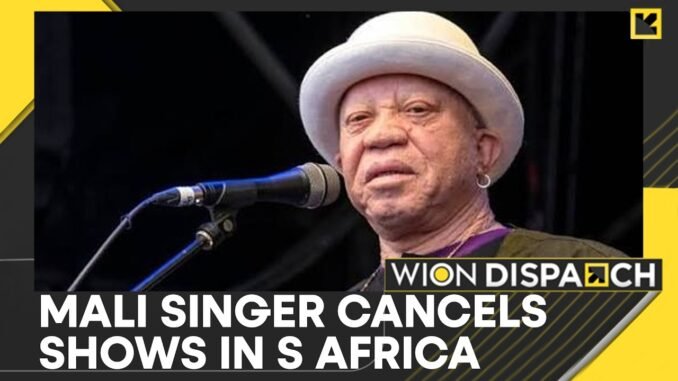

Legendary Malian musician Salif Keita has taken a powerful stand that has set tongues wagging across Africa — the iconic singer has cancelled all his planned commercial shows in South Africa, and his reason is one that every African, including Nigerians, should sit down and think deeply about.
The “Golden Voice of Africa” made it clear that he simply cannot look the other way while xenophobic violence continues to be unleashed on African migrants living in South Africa. For Keita, showing up to perform and collect his performance fees would amount to business as usual — and that, he says, is something his conscience will not allow.
When African Blood Flows, Can We Dance?
This is the question Salif Keita is essentially asking the entertainment world. While many artistes might separate their craft from politics, this Mali-born music legend has drawn a firm line in the sand. His decision is reminiscent of the kind of bold, principled stances that figures like Fela Kuti made famous here in Nigeria — using one’s platform not just to entertain, but to speak truth to power and demand better from society.
Nigerians know this pain all too well. Many of our brothers and sisters have been caught up in the waves of xenophobic attacks that have periodically swept through South African townships, with Nigerian-owned businesses looted and destroyed, and compatriots left traumatised and displaced. The images of burning shops and fleeing Nigerians are not abstract headlines for us — they hit close to home.
“I Cannot Ignore This”
Keita’s message was simple but loaded with moral weight. He could not, in good conscience, fly into South Africa, perform for cheering crowds, pocket his appearance fees, and pretend that nothing is happening to his fellow Africans on the very same soil.
It is the kind of statement that forces us to ask ourselves hard questions. How many of our own entertainers, business leaders, and public figures have continued to operate comfortably in spaces where injustice thrives, simply because it did not directly affect their pockets?
The Bigger Pan-African Conversation
Keita’s cancellation is more than a scheduling change — it is a reminder of a pan-African ideal that our founding fathers, from Kwame Nkrumah to Nigeria’s own Nnamdi Azikiwe, once championed passionately: that an attack on one African is an attack on all Africans.
The cruel irony of xenophobia in South Africa is not lost on the continent. This is a nation that the rest of Africa rallied behind during the dark years of apartheid. Nigerian students protested, African governments applied pressure, and the continent held its breath until Nelson Mandela walked free. Today, the descendants of that liberation struggle are, in some cases, turning on the very continental neighbours whose solidarity helped set them free.
What Should Nigeria and Africa Do?
Keita’s gesture, while symbolic, carries weight. But symbols must translate into action. African governments — including Nigeria’s — must continue to press South Africa at diplomatic levels to protect the lives and livelihoods of foreign nationals on its soil. The African Union must move beyond strongly-worded statements and implement frameworks that genuinely protect the free movement and safety of Africans across the continent.
And for the rest of us — ordinary Nigerians going about our daily lives — perhaps Salif Keita’s decision is an invitation to think about how we respond when injustice happens to our African family, even when it is not trending on Twitter.
As we say in Nigeria: “Ẹni tó bá jẹ ẹni tìrẹ jẹ, ẹni tó bá pa ẹni tìrẹ, pa.” — What is done to your kinsman is done to you.
Salif Keita may have cancelled his shows. But in doing so, he has given Africa a performance worth far more than any concert ticket.
What do you think about Salif Keita’s decision? Should more African artistes take similar stands? Drop your thoughts in the comments below.
Get all the details on buzzUp9ja
Be the first to comment