
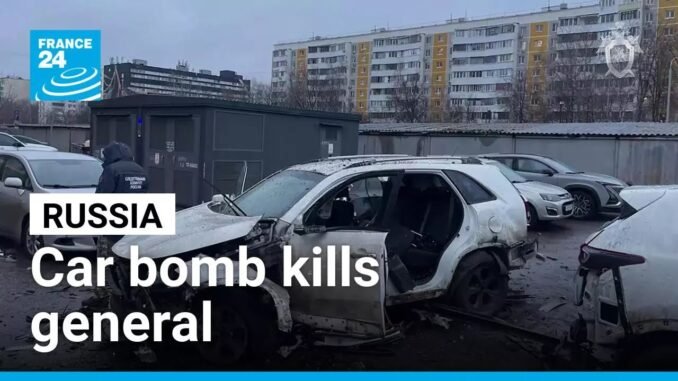

Summary: A Russian general accused of war crimes in Ukraine has reportedly been killed in a bomb explosion at a military base in Russia’s Khabarovsk region.
In a dramatic turn of events that reads like something from a Hollywood thriller, a senior Russian military officer accused of horrific war crimes in Ukraine has reportedly been eliminated by a bomb hidden inside an ordinary mailbox at a Russian military base.
The Attack That Shook a Russian Military Base
The explosion rocked a military facility in Russia’s Khabarovsk region, specifically targeting Azatbek Omurbekov, a colonel who earned the chilling nickname “Butcher of Bucha” for his alleged role in atrocities committed against Ukrainian civilians during Russia’s invasion of Ukraine.
According to reports emerging from the region, the bomb was cleverly concealed inside what appeared to be a regular mailbox at the military base. When Omurbekov approached or opened the mailbox, the explosive device detonated, causing fatal injuries.
Who Was Azatbek Omurbekov?
For Nigerians following the Russia-Ukraine conflict, Omurbekov’s name may ring a bell for all the wrong reasons. He commanded the 64th Separate Guards Motor Rifle Brigade, a unit that Ukrainian authorities have directly linked to mass killings, torture, and other war crimes committed in the town of Bucha, near Kyiv.
The discovery of hundreds of civilian bodies in Bucha after Russian forces withdrew in March 2022 shocked the world. Images of corpses lying in the streets, evidence of torture, and mass graves sparked international outrage and led to calls for war crimes investigations.
Ukraine’s government has specifically accused Omurbekov and his unit of being responsible for these atrocities, leading to his infamous moniker.
A Sophisticated Operation
The method of assassination—a bomb planted in a mailbox at a military base deep inside Russian territory—suggests a highly sophisticated intelligence operation. Such an attack would require:
– Detailed knowledge of the target’s movements and routines
– Access to a secured military facility
– Technical expertise in explosives
– Careful planning and execution
While no group has immediately claimed responsibility for the attack, the targeting of a figure accused of war crimes has raised questions about whether this was a Ukrainian special operation, the work of anti-Kremlin Russian partisans, or another actor entirely.
What This Means for the Ongoing Conflict
This incident, if confirmed, would mark another significant strike against Russian military leadership on Russian soil. Over the past two years of the conflict, several high-ranking Russian officers and pro-Kremlin figures have been killed or injured in attacks within Russia’s borders.
For Nigerians and other observers of international affairs, this development highlights several important points:
1. The reach of modern warfare: Conflicts no longer remain confined to traditional battlefields. Intelligence operations can strike deep within enemy territory.
2. Accountability for war crimes: Whether through legal channels or other means, those accused of atrocities may eventually face consequences.
3. The evolution of the conflict: As the Russia-Ukraine war continues into its third year, tactics and strategies continue to evolve on both sides.
International Reaction and Implications
The international community, including organizations like the International Criminal Court (ICC), has been investigating alleged war crimes committed during the Russia-Ukraine conflict. The ICC has even issued an arrest warrant for Russian President Vladimir Putin himself on charges related to the unlawful deportation of Ukrainian children.
This latest incident, regardless of who orchestrated it, sends a clear message: those accused of war crimes may not escape accountability, even within their own borders.
The Broader Context
For Nigerian readers, this story offers important lessons about international justice, the consequences of military aggression, and the complex nature of modern conflicts. It also serves as a reminder that in today’s interconnected world, actions have consequences that can reach across borders and years.
As the Russia-Ukraine conflict continues to evolve, with no clear end in sight, incidents like this demonstrate that the war extends far beyond the trenches and battlefields, into the shadows of intelligence operations and targeted strikes against those accused of the most serious crimes.
The death of the “Butcher of Bucha,” if confirmed, closes one chapter in the ongoing saga of accountability for alleged war crimes in Ukraine, but many questions remain unanswered about who carried out this daring operation and what it means for the future of the conflict.
As this is a developing story, details continue to emerge. The full circumstances surrounding the explosion and confirmation of casualties are still being verified by independent sources.
Visit buzzUp9ja for more updates
Be the first to comment