

Summary: Arise TV’s Rufai Oseni has called out the Federal Government over what he describes as a glaring double standard in how inflammatory statements are treated depending on who is making them. Here’s why his argument is hitting differently for many Nigerians.**
There is a conversation that many Nigerians have been whispering about in beer parlours, on Twitter spaces, and in office corridors — and now, outspoken broadcaster and Arise Television host, Rufai Oseni, has decided to bring it straight to the public square.
His message? Simple but explosive: In Nigeria, what you can say — and get away with — depends heavily on who you are, where you come from, and which powerful people are backing you.
—
The Double Standard Nobody Wants to Talk About
Oseni pointedly highlighted the stark contrast between how the Federal Government treats different individuals who make controversial or inflammatory public statements.
His argument centres around a question that many Nigerians already know the answer to but dare not ask out loud:
> Why can Sheikh Ahmad Gumi and others like him make certain statements — some of which touch on very sensitive national security issues — and walk away without so much as a knock on their door, while Nnamdi Kanu has been sitting in detention for years over similar allegations?
For those who may need a quick recap:
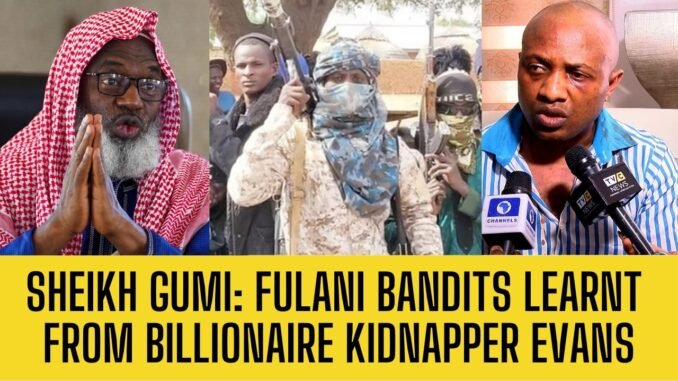
– Sheikh Ahmad Gumi is a prominent Islamic cleric and one of Nigeria’s most controversial religious figures. He has repeatedly made public statements defending bandits, meeting with armed groups in forests, and calling for amnesty for criminals terrorising the North — all largely without any government crackdown.
– Nnamdi Kanu is the leader of the Indigenous People of Biafra (IPOB), who was re-arrested in 2021 and has remained in DSS custody ever since, facing a long list of terrorism-related charges largely connected to his broadcasts and public agitations for Biafran independence.
Both men have made statements that the government found — or could find — uncomfortable. Yet their fates have been dramatically different.
—
Is It About Tribe, Religion, or Just Raw Power?
This is the uncomfortable question at the heart of Oseni’s argument — and frankly, it is one that strikes at the very foundation of Nigeria’s unity.
Many Nigerians from the South-East have long complained that the selective application of the law is one of the clearest signs that the Nigerian state does not treat all its citizens equally. When a Northern cleric can freely negotiate with bandits and terrorists on national television without consequence, but a South-Eastern activist faces life imprisonment for broadcasting his opinions, something is fundamentally broken.
And it is not just about Gumi and Kanu. Oseni’s broader point is about a systemic pattern — one where political connections, religious influence, ethnic identity, and regional loyalty determine whether the full weight of Nigerian law lands on your shoulders or simply passes you by.
—
Why This Matters for Every Nigerian
Whether you support Nnamdi Kanu or not. Whether you agree with Sheikh Gumi’s methods or not. The principle here should concern every single Nigerian.
A country where the law is applied based on who you are rather than what you did is not a country governed by the rule of law — it is a country governed by the rule of men. And history has shown us time and again that when justice becomes selective, resentment builds, trust in institutions collapses, and eventually, everyone suffers.
Nigeria is already grappling with:
– A devastating insecurity crisis across multiple regions
– Deep ethnic and religious tensions
– A young population that is rapidly losing faith in government institutions
– Rising agitation from multiple groups who feel marginalised
Selective justice is fuel on all of these fires.
—
Oseni’s Courage in Asking the Hard Questions
Say what you will about Rufai Oseni — the man has never been shy about calling out power. In a media landscape where many broadcasters are careful not to rock boats that might affect their access or sponsorship, voices like his serve an important democratic function.
Asking why the same government that has kept Nnamdi Kanu locked up for years has never moved against Sheikh Gumi with the same energy is not a radical question. It is, in fact, the most basic question any functioning democracy should be able to answer.
The Federal Government owes Nigerians a clear, consistent, and transparent explanation for how it decides who crosses the line — and more importantly, what happens to them when they do.
—
The Bottom Line
Nigeria cannot preach unity with one mouth and practise division with both hands. If making inflammatory statements is a crime, then it must be a crime for everyone — Sheikh, Pastor, activist, or politician.
Until that day comes, voices like Rufai Oseni’s will keep asking the question that the powerful hope ordinary Nigerians will forget to ask:
Why do some people get to say anything — and walk free — while others pay with their freedom?
The answer to that question tells you everything you need to know about the Nigeria we currently live in.
For more information, check buzzUp9ja
Be the first to comment