
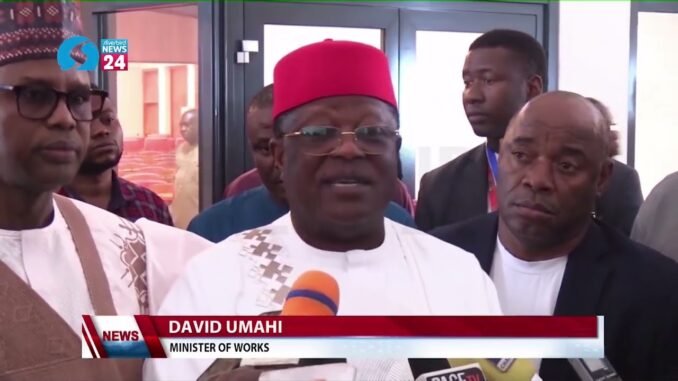

Summary: Minister of Works David Umahi defends Tinubu’s borrowing strategy, explaining how loans are funding critical road infrastructure across Nigeria. Get the full details on the debt debate.
The Minister of Works, David Umahi, has come out to defend the Tinubu administration’s borrowing approach, insisting that the loans are essential for fixing Nigeria’s crumbling road infrastructure. This statement comes as economic analysts reveal that since President Bola Ahmed Tinubu took office in May 2023, his government has accumulated between ₦57 trillion and ₦65.9 trillion in new public debt.
Why All This Borrowing?
For many Nigerians struggling with the rising cost of living, hearing about trillions in new debt can be unsettling. After all, we’ve seen fuel prices skyrocket, food prices climbing daily, and our naira struggling against the dollar. So when government officials talk about massive borrowing, it naturally raises eyebrows.
But according to Umahi, there’s method to what might seem like madness. The former Ebonyi State governor explained that the borrowed funds are being channeled into rebuilding Nigeria’s road network, which has deteriorated significantly over the years.
The State of Our Roads
Anyone who has traveled across Nigeria knows the sorry state of our roads. From the dreaded Lagos-Ibadan expressway to the nightmare that is the Benin-Ore road during rainy season, our road infrastructure has long been a source of frustration for motorists, transporters, and businesses alike.
Bad roads don’t just damage vehicles and cause accidents – they increase transportation costs, which in turn drives up the prices of goods and services. When a trailer transporting tomatoes from the North spends extra days on the road due to bad routes, or when goods get damaged from potholes and rough terrain, guess who pays? The final consumer – you and me.
The Borrowing Debate
The Tinubu administration’s borrowing spree has sparked intense debate among economists, political analysts, and everyday Nigerians. Critics argue that piling up debt without corresponding revenue growth is a recipe for economic disaster. They point to countries like Sri Lanka and Ghana that recently faced debt crises as cautionary tales.
On the other hand, supporters argue that infrastructure development requires massive capital investment, and borrowing for development is standard practice worldwide. They insist that good roads will eventually pay for themselves by boosting economic activity and reducing business costs.
What Umahi Is Saying
The Works Minister has been emphatic that Nigerians will see tangible results from the borrowing. According to him, the funds are not being diverted into private pockets but are actively being used to construct and rehabilitate roads across the country.
Umahi highlighted several ongoing road projects, suggesting that the administration is serious about delivering infrastructure that will outlast its tenure. He urged Nigerians to be patient and give the government time to complete these projects.
The Real Questions Nigerians Are Asking
While the explanation sounds reasonable, many Nigerians have legitimate concerns:
1. Transparency: Where exactly is this ₦57-65 trillion going? Which specific roads are being built or fixed? Nigerians want detailed breakdowns, not general statements.
2. Track Record: We’ve heard promises about road construction before. Previous administrations borrowed money too, yet our roads remained in deplorable condition. What makes this different?
3. Debt Sustainability: With our revenue challenges and the naira’s weakness, how do we plan to repay these loans? Will we be taking new loans to service old ones?
4. Value for Money: Are we getting quality construction that will last, or are we paying inflated prices for substandard work that will require repairs in a few years?
The Economic Reality
Nigeria’s debt profile has become increasingly worrying. Our debt service-to-revenue ratio has been alarmingly high, meaning a significant portion of government income goes straight to servicing loans rather than funding education, healthcare, or security.
With crude oil production below targets and revenue generation still heavily dependent on oil, taking on more debt without diversifying income sources is risky business. The recent removal of fuel subsidy and forex reforms were partly aimed at freeing up funds and increasing revenue, but their impact on ordinary Nigerians has been severe.
What Good Roads Could Mean for Nigeria
Despite the concerns, there’s no denying that good road infrastructure could transform Nigeria’s economy:
– Reduced Transport Costs: Better roads mean lower vehicle maintenance costs and faster delivery times, which should eventually translate to lower prices for goods.
– Improved Safety: Good roads reduce accidents, saving lives and reducing healthcare costs.
– Economic Integration: Reliable road networks connect markets, making it easier for farmers, traders, and manufacturers to move goods across the country.
– Attracting Investment: Foreign investors consider infrastructure when deciding where to invest. Good roads signal that a country is serious about business.
– Job Creation: Road construction employs thousands of workers directly and indirectly.
The Accountability Challenge
For this borrowing to make sense, Nigerians need to see results. The government must demonstrate that:
1. Contracts are awarded transparently without inflated costs
2. Projects are completed within reasonable timeframes
3. Quality standards are maintained
4. Funds are not diverted through corruption
The Tinubu administration must also communicate clearly with citizens about debt levels, repayment plans, and the specific benefits delivered.
What Should Nigerians Watch Out For?
As this infrastructure push continues, concerned citizens should:
– Monitor Projects: Pay attention to road projects in your area. Are they progressing? Is the quality acceptable?
– Demand Transparency: Use Freedom of Information requests and social media to push for detailed breakdowns of spending.
– Track Debt Figures: Keep an eye on Nigeria’s total debt profile and debt service costs through official releases from the Debt Management Office.
– Engage Constructively: Hold leaders accountable through constructive criticism rather than just complaints.
The Verdict
Minister Umahi’s defense of the borrowing strategy raises important points about the need for infrastructure investment. Good roads are indeed essential for economic development, and no serious country can prosper with the kind of road network we currently have.
However, borrowing must be done responsibly, with clear plans for repayment and transparent deployment of funds. Nigerians have been disappointed too many times by grand promises that yielded little.
The success or failure of this approach will ultimately be judged by what Nigerians can see and experience on the ground. If, in the next two years, we begin seeing significant improvements in our road network – smoother journeys, reduced transport costs, fewer accidents – then perhaps the borrowing will be justified.
But if, as has happened before, we accumulate massive debt with little to show for it, then future generations will rightfully question the wisdom of today’s decisions.
For now, the Tinubu administration has made its bet: borrow big, build infrastructure, and trust that economic growth will follow. Time will tell if it’s a winning strategy or another expensive mistake.
What do you think? Is borrowing for infrastructure the right move for Nigeria now, or should we find other ways to fix our roads? Share your thoughts in the comments below.
Stay tuned for more news on buzzUp9ja
Be the first to comment