
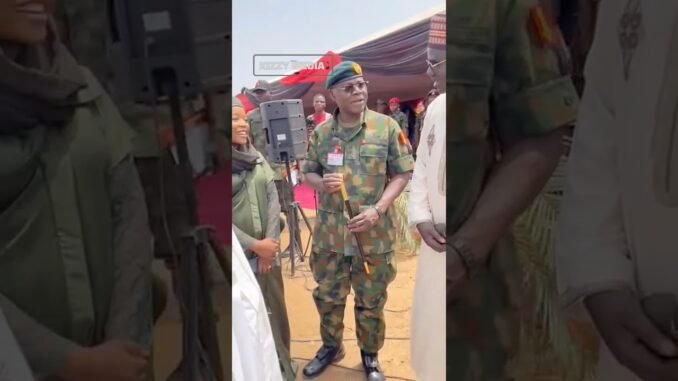

Summary: Former Chief of Army Staff Tukur Buratai reveals how politicians allegedly benefit from Nigeria’s security challenges, linking insecurity to political transitions and vested interests.
The former Chief of Army Staff, Lieutenant General Tukur Buratai (rtd), has made explosive allegations that some Nigerian politicians are deliberately fueling the country’s security crisis for personal and political gain.
In a statement that has sent shockwaves across the nation, Buratai directly linked the escalating waves of banditry, kidnapping, and school abductions to political transitions and the calculated activities of certain political actors who allegedly have vested interests in keeping Nigeria unstable.
The Political Economy of Insecurity
According to the retired general, Nigeria’s security challenges are not merely criminal or terrorist activities happening in isolation. Rather, he suggests there’s a sophisticated network of political beneficiaries who thrive when the nation is engulfed in chaos.
“The insecurity we are experiencing is not accidental,” Buratai implied, pointing to patterns that emerge during political transition periods when incidents of banditry and kidnappings seem to intensify.
This revelation raises disturbing questions about who truly benefits when Nigerian students are abducted from their schools, when farmers cannot access their farms in the North, or when communities in the South-East face security threats.
Following the Money Trail
Buratai’s allegations suggest that some politicians use insecurity as:
– A campaign tool – Creating fear and positioning themselves as saviors
– A distraction – Diverting attention from governance failures
– A business venture – Through ransom payments and security contracts
– Political leverage – Destabilizing rival regions or administrations
These claims echo what many Nigerians have long suspected but rarely hear from military leaders of Buratai’s standing.
The School Abduction Epidemic
The targeting of schools – from Chibok to Dapchi, from Kankara to the numerous Kaduna kidnappings – has become a recurring nightmare for Nigerian parents. Buratai’s suggestion that political calculations may be involved in these heinous acts adds another dark layer to an already tragic situation.
Every time children are snatched from their classrooms, the entire nation holds its breath. Parents in the North now think twice before sending their children to school. The psychological and educational damage is incalculable.
What This Means for Nigeria
If Buratai’s allegations hold water, Nigeria faces a problem far more complex than conventional security responses can address. It means:
1. Military solutions alone won’t work if the problem is political
2. Genuine political will is required to end the crisis
3. Follow the money – tracking ransom payments and security spending could reveal uncomfortable truths
4. Electoral reforms may be necessary to remove incentives for crisis creation
The Nigerian Reality Check
For ordinary Nigerians hustling daily in Lagos, farming in Benue, trading in Kano, or studying in Kaduna, these political games come at a terrible human cost. While politicians allegedly play chess with people’s lives, families are burying loved ones, paying ransoms they can’t afford, and living in perpetual fear.
The question now is: Will anyone investigate these serious allegations? Will the National Assembly summon the courage to probe the nexus between politics and insecurity? Or will Buratai’s words fade into the background noise of Nigeria’s troubled security discourse?
A Call for Accountability
Buratai’s position as a former military chief lends weight to these allegations. This isn’t a random politician making unsubstantiated claims – this is someone who commanded Nigeria’s army speaking from experience.
The Nigerian public deserves answers. Security agencies must investigate the political dimensions of our insecurity challenges. Anti-corruption bodies should follow the money trail of ransom payments. And ultimately, politicians who profit from chaos must face justice.
The Way Forward
Nigeria cannot afford to continue on this trajectory. Every day that insecurity persists, our economy suffers, our children’s education is disrupted, and our national psyche is damaged.
If some of our leaders are truly benefiting from keeping Nigeria insecure, then the fight against terrorism and banditry must also become a fight against corrupt political interests. Only then can we hope for lasting peace.
The ball is now in the court of President Bola Tinubu’s administration, the security agencies, and ultimately, the Nigerian people who must demand accountability from those who seek to govern them.
What are your thoughts on Buratai’s allegations? Have you noticed patterns linking political seasons to increased insecurity? Share your views in the comments below.
For more details, check buzzUp9ja
Be the first to comment