
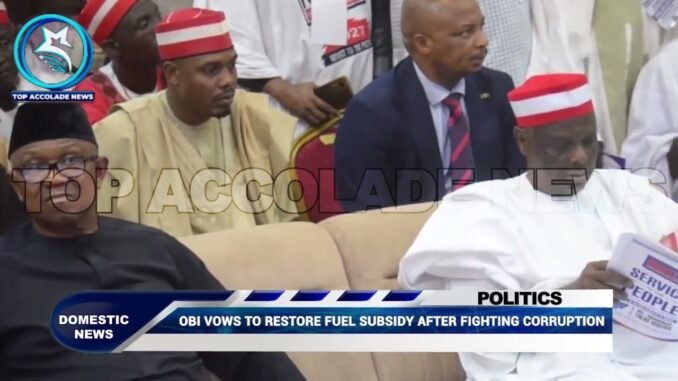

Summary: Presidential candidate Peter Obi of the NDC has promised Nigerians that he will bring back petroleum subsidy — but with a crucial condition attached. Here’s everything you need to know.
If there is one topic that never fails to get Nigerians talking — from the pepper soup joints in Onitsha to the beer parlours in Lagos Island — it is fuel subsidy. And now, Peter Obi, the presidential candidate of the Nigeria Democratic Congress (NDC), has thrown himself right into the middle of that conversation with a bold promise: he will bring back petroleum subsidy if Nigerians hand him the keys to Aso Rock.
But here is the catch — and it is a big one.
No Subsidy Without Accountability
Obi made it clear that restoring the subsidy would not happen overnight. According to him, his administration would first have to tackle the monster that turned the old subsidy regime into a feeding trough for a handful of powerful individuals — corruption.
For many Nigerians, this position will ring familiar. The subsidy removal that rocked the country was largely justified on the grounds that the scheme had become a massive corruption racket, with billions of naira disappearing into private pockets while ordinary Nigerians continued to suffer at the pumps. NNPC figures, audit reports, and investigative journalism had long painted a damning picture of a system that enriched the few at the expense of the many.
Obi appears to understand this history well — and is betting that Nigerians do too.
Why This Promise Matters to the Average Nigerian
Let us be honest: the removal of fuel subsidy hit everyday Nigerians where it hurts the most. Transport fares shot up. The cost of foodstuffs in markets from Kano to Port Harcourt climbed sharply. Small business owners who depend on generators saw their operating costs multiply overnight. For millions of Nigerians already navigating the harsh realities of rising inflation and unemployment, subsidy removal was not just a policy change — it was a body blow.
So when a presidential candidate promises to bring it back, ears perk up across the country — and rightly so.
Can Corruption Really Be Fixed First?
Here is where many Nigerians will rightly raise an eyebrow. Tackling corruption before restoring subsidy sounds good on paper, but Nigeria has heard similar promises before. Every administration since the return to democracy in 1999 has campaigned on fighting corruption — yet here we are.
The questions Nigerians should be asking are:
– What specific anti-corruption measures does Peter Obi plan to implement?
– What timeline is he working with before subsidy restoration becomes feasible?
– How will the restored subsidy be structured to prevent the same loopholes that made the old system a cash cow for cronies?
Without clear answers to these questions, the promise — however appealing — risks sounding like yet another campaign slogan designed to win votes rather than drive real change.
The Bigger Picture
Peter Obi has built his political brand around fiscal responsibility and prudent governance, often pointing to his record as Governor of Anambra State as evidence that he can manage public funds effectively. His supporters — many of them young, urban, and deeply frustrated with the political establishment — believe he represents a genuine departure from business as usual.
His subsidy promise, conditional as it is, fits neatly into that narrative: we will give Nigerians relief, but we will do it the right way this time.
Whether that message resonates broadly enough — and whether voters trust that the “right way” is actually achievable — may well shape a significant part of his electoral fortunes.
One thing is certain: in a country where fuel price is deeply personal, any candidate willing to talk seriously about subsidy is guaranteed to have Nigerians listening. The real test will be in the details — and ultimately, in the doing.
Connect with buzzUp9ja for more
Be the first to comment