
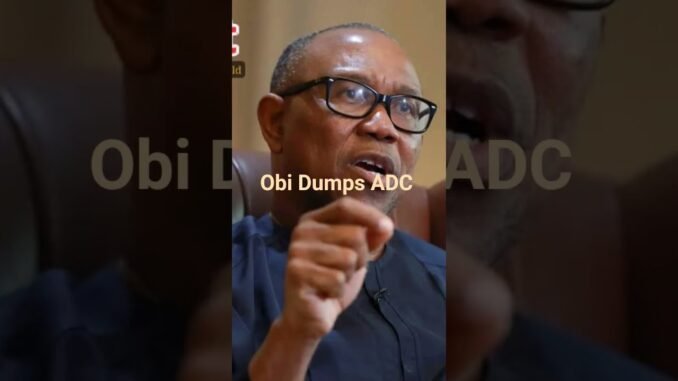

A prominent ADC chieftain has accused the former Anambra governor of setting back the Southeast’s presidential ambitions by decades through his political movements.
Hon. Kasimu Maigari, a key member of the African Democratic Congress (ADC) National Legislators’ Forum, has made a controversial claim that former Labour Party presidential candidate Peter Obi has significantly set back the quest for an Igbo presidency by approximately two decades.
Maigari’s assertion comes amid ongoing debates about the political future of the Southeast region and the strategic choices made by its leading figures in recent election cycles.
The Context of Obi’s Political Journey
Peter Obi’s political trajectory has been nothing short of dramatic. The former Anambra State governor initially joined the ADC before his historic move to the Labour Party ahead of the 2023 presidential elections. His decision to pitch tent with Labour Party transformed what was previously considered a fringe political platform into a formidable force, particularly among Nigerian youths and urban voters.
The “Obidient” movement that emerged from his presidential campaign captured the imagination of millions of Nigerians who were hungry for alternative leadership outside the traditional political establishments of the All Progressives Congress (APC) and Peoples Democratic Party (PDP).
Maigari’s Controversial Position
According to Maigari, Obi’s departure from the ADC represented a missed opportunity for the Southeast region to build a sustainable political structure that could have delivered an Igbo presidency sooner rather than later.
While the specifics of Maigari’s argument weren’t fully detailed in available reports, political analysts suggest that his position likely revolves around the belief that the ADC provided a more viable institutional framework for achieving Southeastern political aspirations than the Labour Party.
The Igbo Presidency Question
The quest for a Nigerian president of Igbo extraction remains one of the most sensitive and enduring conversations in Nigerian politics. Since the end of the civil war in 1970, the Southeast has produced only one substantive head of state – General Aguiyi Ironsi, whose tenure was brief and ended tragically.
Many Southeastern leaders and citizens have long argued that equity, fairness, and true national unity demand that the region be given an opportunity to produce Nigeria’s president. This sentiment intensified after the conclusion of President Muhammadu Buhari’s eight-year tenure, with many expecting major political parties to zone their tickets to the Southeast.
Did Obi Make the Right Choice?
This question continues to generate heated debate across Nigerian political circles. Supporters of Peter Obi argue that his move to Labour Party was strategically brilliant, as it allowed him to:
– Break free from the constraints of party politics dominated by godfathers
– Build a youth-driven movement that transcended ethnic and religious boundaries
– Secure unprecedented visibility and support across Nigeria
– Challenge the political status quo in ways that wouldn’t have been possible within traditional party structures
Critics, however, including Maigari, suggest that Obi’s approach prioritized personal ambition over collective Southeastern interests, potentially fragmenting the region’s political capital and bargaining power.
The 2023 Election Reality Check
The 2023 presidential election results showed that while Obi performed exceptionally well in the Southeast, South-South, and urban centers across Nigeria, he ultimately came third behind Bola Ahmed Tinubu of the APC and Atiku Abubakar of the PDP.
Some political observers argue that this outcome validates concerns about the Labour Party’s structural weaknesses as a platform for achieving presidential victory, particularly given Nigeria’s complex political landscape where party structures, financial resources, and established political networks play crucial roles.
What Does This Mean for Southeastern Politics?
Maigari’s statement raises important questions about the future political strategy of the Southeast region:
Strategic Unity vs. Individual Ambition: Should Southeastern politicians prioritize building consensus behind single candidates and parties, or should they continue to spread across various political platforms?
Party Building vs. Movement Politics: Is the future of Igbo political aspirations better served by strengthening existing party structures or by building popular movements that can disrupt traditional political patterns?
Timeline and Patience: With Maigari claiming a 20-year setback, how should Southeastern politicians recalibrate their strategies for the 2027 elections and beyond?
Different Perspectives on the Issue
The Obi Loyalist View: Many supporters see Peter Obi as having elevated the political consciousness of an entire generation and brought the Southeast closer to national relevance than any recent politician from the region. They argue that his impact transcends immediate electoral victory.
The Pragmatist View: Some political analysts believe that the Southeast needs to develop stronger alliances with other regions and work within established political structures to achieve the presidency, rather than relying on popular movements alone.
The ADC Perspective: Members of the ADC, like Maigari, feel that the party offered a middle ground – a structured platform with national reach that could have been built into a formidable force with proper investment and commitment from leading figures like Obi.
Lessons for Nigerian Politics
This debate highlights several critical issues in Nigerian political discourse:
1. The tension between ethnic regional interests and national appeal
2. The challenge of building sustainable political movements versus riding popular waves
3. The importance of institutional strength in delivering electoral victories
4. The need for strategic thinking beyond single election cycles
Looking Ahead to 2027 and Beyond
As Nigeria looks toward the 2027 elections, the Southeast region faces crucial decisions about its political future. Will leaders coalesce around a unified strategy, or will the fragmentation that characterized 2023 continue?
Peter Obi himself has remained politically active, maintaining his criticism of the current administration and keeping his support base engaged. Whether he remains with the Labour Party, returns to a platform like ADC, or charts an entirely new course remains to be seen.
The Broader Context
Maigari’s criticism must also be understood within the context of inter-party rivalry and the natural tensions that arise when prominent politicians move between parties. The ADC, like many other parties outside the major two, has struggled to maintain relevance and may view Obi’s departure as a lost opportunity for its own growth.
Conclusion
Hon. Kasimu Maigari’s assertion that Peter Obi’s departure from ADC has set back Igbo presidency aspirations by 20 years is a provocative claim that demands serious consideration. While it may overstate the case, it raises valid questions about political strategy, regional unity, and the path forward for Southeastern political ambitions.
What remains clear is that the quest for an Igbo presidency requires more than individual brilliance or popular appeal – it demands strategic thinking, coalition building, and perhaps most importantly, unity of purpose among Southeastern political leaders.
As Nigeria’s political landscape continues to evolve, the lessons from the 2023 elections and the debates they have sparked will likely shape political strategies for years to come. Whether Maigari’s 20-year timeline proves accurate will depend largely on the choices Southeastern leaders make in the coming election cycles.
What do you think? Did Peter Obi make the right choice leaving ADC for Labour Party? How can the Southeast achieve its presidential ambitions? Share your thoughts in the comments below.
For more details, check buzzUp9ja
Be the first to comment