
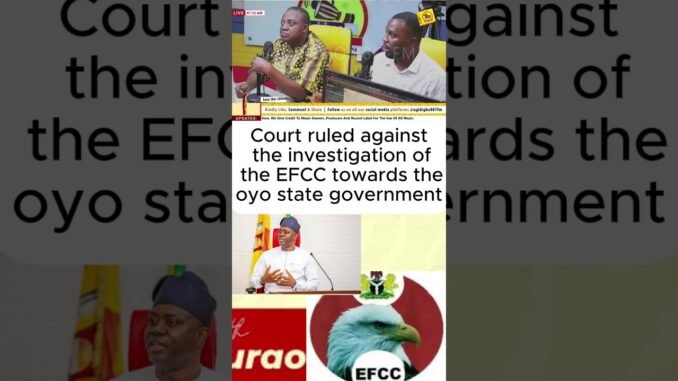

Summary: A Federal High Court in Ibadan has put the brakes on the EFCC’s planned investigation into Oyo State’s finances. Here’s everything you need to know about this landmark ruling and what it means for state autonomy in Nigeria.
In a significant legal development that has sent ripples across Nigeria’s political landscape, a Federal High Court sitting in Ibadan has slammed the brakes on the Economic and Financial Crimes Commission (EFCC), barring the anti-graft agency from proceeding with its planned investigation into the financial affairs of the Oyo State Government.
What Happened?
The Federal High Court in Ibadan delivered a ruling that effectively ties the hands of the EFCC, at least for now, preventing the commission from digging into the finances of the Oyo State Government. The court’s intervention came at a critical moment, raising important questions about the boundaries of federal agency powers and the financial sovereignty of state governments in Nigeria.
Why This Matters to Nigerians
For everyday Nigerians — from the traders at Dugbe Market in Ibadan to civil servants across Oyo State — this ruling touches on something much bigger than courtroom drama. It speaks directly to how public funds are managed, who holds governments accountable, and where the line is drawn between federal oversight and state autonomy.
Nigeria’s federal structure has always been a delicate balancing act. While agencies like the EFCC play a crucial role in fighting corruption across the country, state governments have consistently argued that certain investigations can be used as political weapons rather than genuine anti-corruption efforts.
The Bigger Picture
This is not the first time a state government has sought judicial protection against what it considers overreach by federal agencies. Across Nigeria, the tension between Abuja and the states has played out in courtrooms, boardrooms, and even on the streets.
The EFCC, since its establishment, has been one of Nigeria’s most powerful tools in the fight against financial crimes. However, critics have long argued that its investigations are sometimes selectively deployed, particularly against governors or states that find themselves on the wrong side of federal political interests.
What Comes Next?
With the court order now in place, the EFCC is legally obligated to stand down — at least until the matter is fully determined by the court. Legal analysts are watching closely to see whether the commission will challenge the ruling or comply while the case proceeds.
For the Oyo State Government, this is a temporary reprieve, but the underlying questions about financial transparency and accountability remain very much on the table. Nigerians, as always, deserve to know how their money is being spent — regardless of which government is in the crosshairs.
Stay with us for updates as this story continues to develop.
Uncover more updates on buzzUp9ja
Be the first to comment