
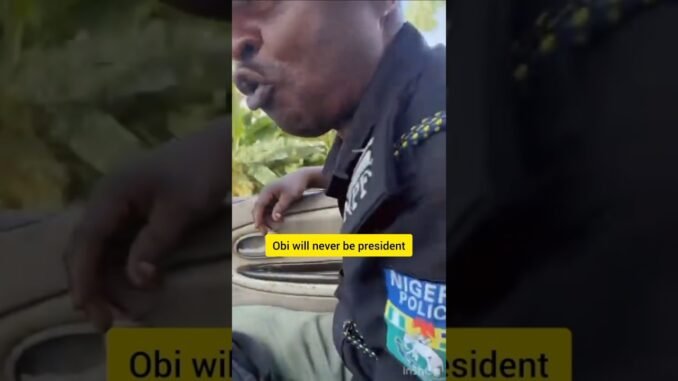

A shocking video making the rounds on social media has left many Nigerians furious after a police officer was caught on camera making deeply troubling remarks about Labour Party presidential candidate Peter Obi, suggesting his Igbo heritage is a barrier to the presidency.
—
The video, which has since gone viral across Twitter, Facebook, and WhatsApp groups nationwide, shows a uniformed Nigerian police officer openly declaring that Peter Obi stands no chance of becoming Nigeria’s president — not because of his policies or track record — but simply because he is Igbo.
For millions of Nigerians who have rallied behind the Obidient movement, the remarks hit like a thunderbolt. The clip has reignited conversations about tribalism, ethnic discrimination, and whether Nigeria’s unity is truly more than just the words printed on our Naira notes.
“Na Wa O” — Nigerians React With Anger and Disappointment
Social media users wasted no time in expressing their outrage. Many Nigerians questioned how a uniformed officer, sworn to protect and serve all Nigerians regardless of tribe or tongue, could openly display such ethnic bias.
“This is exactly what we are fighting against,” one Twitter user wrote. “A police officer funded by taxpayers from every tribe in Nigeria is sitting there and telling us an Igbo man cannot lead. Chai!”
The remarks cut deep, particularly because they came from someone in a position of authority — someone who is supposed to represent the Nigerian state and its constitutional values of fairness and equal opportunity for every citizen.
The Bigger Question Nigeria Must Answer
This incident is not just about one officer’s careless words. It pulls back the curtain on a deeper, more uncomfortable truth that many Nigerians already know but rarely discuss openly — ethnic bigotry remains a powerful, suffocating force in our national politics.
Nigeria’s constitution is clear: every Nigerian citizen, regardless of state of origin, tribe, or religion, is qualified to contest for the office of the President. Yet, in living rooms, beer parlours, offices, and apparently even among security personnel, whispers — and now open declarations — about which ethnic group “deserves” power continue to poison our national conversation.
The Igbo people, as one of Nigeria’s three major ethnic groups, have never produced a democratically elected president since the nation’s return to democracy in 1999. For many, Peter Obi represented a genuine chance to change that narrative — not through ethnic sentiment, but through competence, accountability, and a track record that Nigerians across the South-West, North, and beyond found compelling.
A Police Force That Must Reflect Our Diversity
Beyond the politics, this video raises serious questions about professionalism and bias within the Nigerian Police Force. If an officer can casually dismiss a presidential candidate’s eligibility based on ethnicity while in uniform, what does that say about how such officers might treat ordinary Igbo citizens seeking justice or protection?
The Nigerian Police Force has a responsibility to retrain, re-orientate, and hold officers accountable for conduct that undermines national cohesion. Nigerians deserve a police force that serves the eagle, not just one wing of it.
The Obidient Movement and the Dream of One Nigeria
Whatever one’s political leaning, the viral video is a reminder of why movements like the Obidient movement resonated so powerfully — not just among Igbo Nigerians, but among young people from Kano to Calabar, from Sokoto to Surulere, who are tired of a Nigeria where your last name determines your destiny more than your ability.
Nigeria cannot afford to keep recycling mediocrity wrapped in ethnic loyalty. The country’s challenges — from insecurity to economic hardship, from fuel queues to flooding — do not ask for your tribe before they knock on your door.
—
As the video continues to circulate, many are calling for the officer to be identified and disciplined by the appropriate authorities. The Nigeria Police Force is yet to issue an official statement on the matter.
—
What do you think? Should the officer face disciplinary action? Drop your thoughts in the comments below and share this article to keep the conversation going.
For more information, check buzzUp9ja
Be the first to comment