
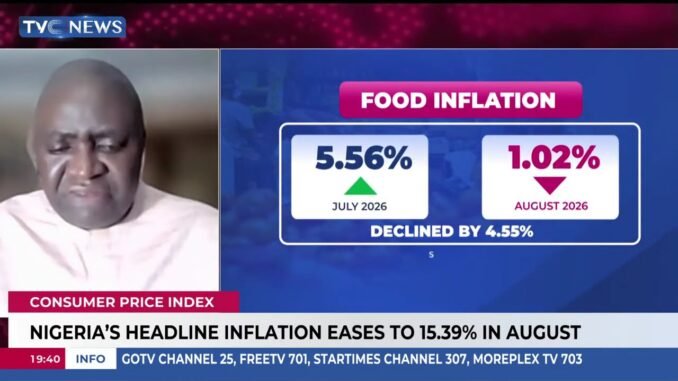

There is a small but noteworthy piece of economic news that Nigerians should pay attention to this week. The country’s headline inflation rate has eased — albeit marginally — to 15.39 percent* in August 2026, coming down from the *15.43 percent recorded in July. The National Bureau of Statistics (NBS) made this announcement, and while the drop may seem like a rounding error on paper, every little relief counts when you are standing at a market stall in Oyingbo, Wuse, or Kejetia wondering why your money never seems to reach far enough.
—
What Is Inflation and Why Should You Care?
For the everyday Nigerian — the trader in Onitsha Main Market, the civil servant in Abuja, or the young professional hustling in Lagos Island — inflation is not just an economic buzzword. It is the reason your plate of eba and egusi soup costs more today than it did last year. It is why your landlord keeps increasing rent and why fueling your generator has become a monthly headache.
Simply put, when inflation rises, the purchasing power of the naira falls. When it eases, as we are seeing now, it means the pace at which prices are climbing is slowing down — which is a step in the right direction, even if prices themselves have not come down.
—
A Marginal Drop, But a Drop Nevertheless
The movement from 15.43% in July* to *15.39% in August may look like a tiny shift, but economists and policymakers will tell you that the direction of travel matters as much as the size of the move. Nigeria has been battling stubborn inflationary pressures for years, driven by factors ranging from fuel subsidy removal and naira depreciation to insecurity disrupting food supply chains across the North.
The fact that inflation is ticking downward — even slightly — suggests that some of the policy interventions being pursued may be beginning to find their footing.
—
What This Means Going Forward
While this is not the moment to pop the champagne or pour a celebratory zobo drink just yet, it is a signal worth watching. Sustained easing of inflation over the coming months would:
– Reduce the cost of living for millions of Nigerian households
– Give the Central Bank of Nigeria (CBN) room to consider adjusting interest rates
– Boost investor confidence in the Nigerian economy
– Ease pressure on businesses struggling with high operating costs
The key question now is whether this downward trend will be sustained into the last quarter of 2026 or whether seasonal factors — such as the lean harvest season or festive period spending — will push prices back up.
—
The Bottom Line
Nigeria’s inflation easing to 15.39% in August 2026 is a modest but welcome development. It will not immediately translate to cheaper tomatoes at the market or lower transport fares on danfo buses, but it is a sign that the economy may be gradually finding its footing. Nigerians have shown incredible resilience in the face of economic hardship, and every positive data point — no matter how small — is worth acknowledging as the country works toward broader economic stability.
Keep watching this space as more data emerges in the coming months.
For more information, check buzzUp9ja
Be the first to comment