

Summary: A Nigerian businesswoman is sparking important conversations about minimum wage compliance. Here’s why every employer in Nigeria needs to pay attention.
A Nigerian businesswoman has set the internet ablaze after calling out employers who shortchange their workers — and honestly, she deserves all the flowers for saying what many employees have been too afraid to voice.
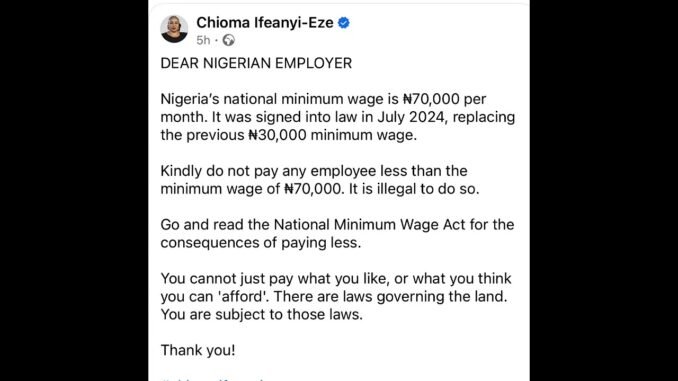
Chioma Ifeanyi-Eze took to Facebook to drop a truth bomb that had many Nigerians nodding in agreement: paying your staff below the minimum wage is not just morally wrong — it is against the law.
—
“You Cannot Just Pay What You Like”
In her now-viral post, Chioma made it crystal clear that Nigerian employers do not have the luxury of deciding arbitrarily what to pay their workers. This is not a matter of what you feel* like paying, or what you *think you can afford — there is a legal floor, and it stands at 70,000 naira.
Her message was direct and unapologetic, the kind of no-nonsense energy Nigerians recognise from that one aunty who will not let you get away with anything at family meetings.
—
What Does Nigerian Law Actually Say?
Nigeria’s National Minimum Wage was reviewed and updated, setting the benchmark that every employer — whether a small fashion boutique in Yaba or a corporate firm on Victoria Island — is expected to meet.
Paying below this amount is a violation of the National Minimum Wage Act, and employees have legal grounds to report such employers.
—
Why This Conversation Matters Right Now
Let’s be honest — with the current economic climate in Nigeria, where the cost of garri, fuel, and rent have all gone through the roof, a salary that does not meet the minimum wage is practically asking your staff to suffer in silence.
Many Nigerian workers, especially fresh graduates desperate for experience and income, accept whatever is offered — sometimes as low as 20k or 30k monthly — because they feel they have no choice. Employers who exploit this vulnerability are not just cutting costs; they are causing real harm to real families.
Chioma’s post is a reminder that:
– ✅ Employees have rights, and those rights are backed by law
– ✅ Employers have responsibilities that cannot be waived by a simple “the economy is hard” excuse
– ✅ If your business cannot afford to pay minimum wage, it needs a better business model — not cheaper labour
—
The Reaction Online
As expected, the post triggered lively debate in the comment sections — because this is Nigeria, and we never shy away from a good argument.
Some agreed wholeheartedly, sharing personal stories of being underpaid at jobs where they worked long hours with little to show for it. Others pushed back, arguing that small businesses and startups genuinely struggle to meet the wage threshold.
But here is the thing — the law does not come with an exemption clause for businesses that claim they cannot afford it.
—
A Word to Nigerian Employers
If you are running a business in Nigeria and your payroll does not reflect the ₦70,000 minimum wage, this is your wake-up call. The labour law is not a suggestion. It is not a recommendation. It is a legal obligation.
Your staff are not volunteers. They have bills, dependants, and dreams — just like you do.
And to Nigerian workers reading this: know your rights. You are entitled to at least the minimum wage, and no amount of “we are like family here” energy from your employer changes that fact.
What do you think? Should the minimum wage be even higher given Nigeria’s current economic realities? Drop your thoughts in the comments below.
For more information, check buzzUp9ja
Be the first to comment