
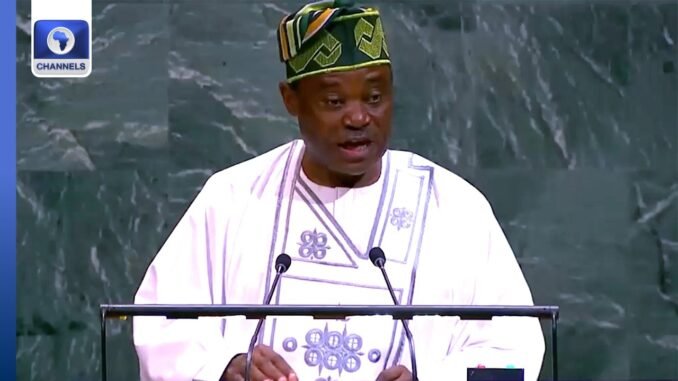

Summary: Nigeria’s UN Ambassador Jimoh Ibrahim has confirmed that Nigeria does not possess nuclear weapons and has never pursued a nuclear weapons programme. Here’s what this means for Africa’s giant and the global stage.
Nigeria, Africa’s most populous nation and the continent’s largest economy, does not possess nuclear weapons — and has never even attempted to develop one. This was the clear and definitive statement made by Nigeria’s Permanent Representative to the United Nations, Ambassador Jimoh Ibrahim, in a declaration that deserves more attention than it has received.
Straight From the Horse’s Mouth
Ambassador Jimoh Ibrahim, who represents the Federal Republic of Nigeria at the highest table of global diplomacy — the United Nations — made it explicitly clear that Nigeria has no nuclear weapons* and has *never pursued a nuclear weapons programme. Not now. Not before. Not ever.
In a world where nuclear sabre-rattling has become almost routine among certain world powers, Nigeria’s position is both refreshing and significant. For a country of over 200 million people, with the kind of geopolitical weight Nigeria carries on the African continent, this is a bold and principled stance.
Why This Matters for Nigeria and Africa
Let’s be real — Nigeria is a big deal. We are talking about the Giant of Africa, a country that punches above its weight in diplomacy, culture, entertainment, and economic influence. When Nigeria speaks on the world stage, people listen.
The fact that Nigeria has consistently chosen the path of peace and non-proliferation over nuclear ambition sends a powerful message to the rest of the world. It says that development, diplomacy, and dialogue — not weapons of mass destruction — are Nigeria’s tools of engagement.
This aligns with Nigeria’s long-standing commitment to the Treaty on the Non-Proliferation of Nuclear Weapons (NPT), a global agreement designed to prevent the spread of nuclear weapons and promote disarmament.
Nigeria’s Voice for a Nuclear-Free World
Rather than chasing nuclear weapons, Nigeria has historically championed the cause of a nuclear-free Africa*. The country played a key role in establishing the *Treaty of Pelindaba, which created the African Nuclear-Weapon-Free Zone — a landmark agreement that prohibits the development, stockpiling, and use of nuclear weapons across the African continent.
That is the kind of leadership Nigerians should be proud of. While some nations invest billions into weapons that can wipe out entire cities, Nigeria has consistently invested its diplomatic energy into building peace frameworks that protect lives.
What This Means on the Global Stage
In today’s world, where tensions between nuclear-armed states like the United States, Russia, China, and North Korea continue to make headlines — and where countries like Iran remain under intense international scrutiny over their nuclear programmes — Nigeria’s clean record is a diplomatic asset of immense value.
Ambassador Ibrahim’s statement at the UN is not just a factual clarification; it is a reaffirmation of Nigeria’s identity as a responsible and peace-loving nation on the world stage. It tells the international community: “We are here to build, not to destroy.”
The Bigger Picture for Nigerians
For everyday Nigerians — from the trader in Alaba Market to the student in Ahmadu Bello University — this might seem like distant, big-grammar diplomacy. But it has real implications.
Nigeria’s commitment to non-proliferation strengthens our relationships with Western powers, multilateral institutions, and international investors. It keeps Nigeria off sanction lists and out of the kind of international isolation that countries like North Korea face. It allows Nigeria to focus its resources — however stretched they may be — on education, healthcare, infrastructure, and economic development, rather than an expensive and dangerous arms race.
Final Thoughts
Ambassador Jimoh Ibrahim’s declaration is a reminder that Nigeria’s greatest strength has never been military might — it has always been our people, our culture, our resilience, and our voice on the world stage.
In a world increasingly threatened by nuclear conflict, Nigeria stands as proof that a great nation can be powerful without being destructive. And that, in itself, is something every Nigerian should wear with pride.
What do you think about Nigeria’s stance on nuclear weapons? Drop your thoughts in the comments below!
For more updates, visit buzzUp9ja
Be the first to comment