
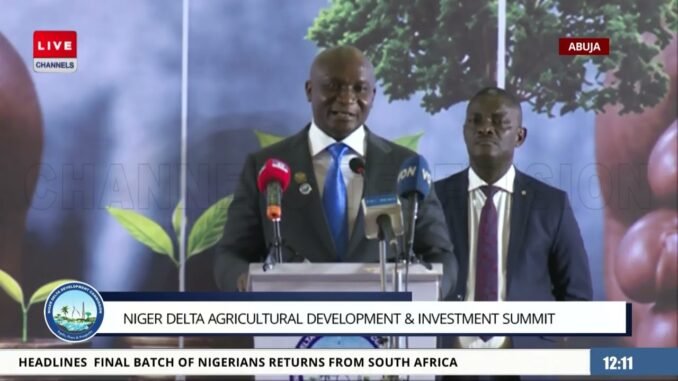

Summary: Vice President Kashim Shettima delivers a bold declaration at the Agric, Development and Investment Summit in Abuja, insisting that Nigeria’s vast resources leave zero excuse for poverty. Here’s what you need to know.
If there is one thing Vice President Kashim Shettima is not short of, it is boldness. At the recently held Agric, Development and Investment Summit in Abuja, the VP took the microphone and said what many Nigerians have been thinking for decades — this country has absolutely no business being poor.
And honestly? He is not wrong.
“We Have Everything We Need”
Delivering the keynote address at the summit, VP Shettima made a declaration that resonated across the hall — and rightfully so. Nigeria, a nation blessed with some of the most fertile agricultural land on the African continent, abundant natural resources, a youthful and vibrant population, and a coastline that would make many nations envious, continues to struggle with poverty levels that simply do not match her potential.
From the rich red soils of Benue — Nigeria’s so-called “Food Basket of the Nation” — to the vast plains of the North that once made us a global leader in groundnut and cotton exports, the evidence has always been there. We are not a poor country. We are a country that has, for too long, mismanaged its riches.
Agriculture: The Sleeping Giant We Keep Ignoring
The setting of VP Shettima’s address was no coincidence. The Agric, Development and Investment Summit brought together key stakeholders in Nigeria’s agricultural sector — and the message was clear: it is time to wake up the sleeping giant.
Agriculture remains one of Nigeria’s most underleveraged sectors. At independence, it was the backbone of our economy. Cocoa from the West, groundnuts from the North, palm oil from the East — these were the products that put Nigeria on the global map before oil came along and, some would argue, made us lazy.
Today, with oil revenues declining and the naira under serious pressure, the conversation is finally returning to the land. And that is a good thing.
What This Means for Everyday Nigerians
For the average Nigerian hustling through rising food prices at the market — from the mama put in Surulere to the suya seller in Kano — VP Shettima’s words carry real weight. Because poverty in Nigeria is not abstract. It shows up in the price of a bag of rice. It shows up in children who cannot afford school fees. It shows up in the daily struggle that has become almost normalized.
But here is the truth: a country sitting on this much agricultural potential should not have citizens who cannot afford to eat well.
The VP’s message is essentially a call to action — to investors, to policymakers, to state governments, and yes, even to ordinary Nigerians — to take agriculture seriously as both a business opportunity and a national duty.
The Road Ahead
Nigeria has heard bold speeches before. What Nigerians now demand — and rightfully so — is action that matches the rhetoric. Investment in irrigation infrastructure, support for smallholder farmers, improved rural roads, access to credit for agric entrepreneurs, and protection from the killer combination of insecurity and climate change ravaging farming communities across the country.
VP Shettima’s words at the summit are a reminder of what is possible. Now, the real work begins.
Because if Nigeria truly has no business being poor, then it is time we started acting like it.
What do you think? Is Nigeria finally turning the corner on agriculture, or are we still stuck in the cycle of big promises and little delivery? Drop your thoughts in the comments below.
Uncover more details on buzzUp9ja
Be the first to comment