
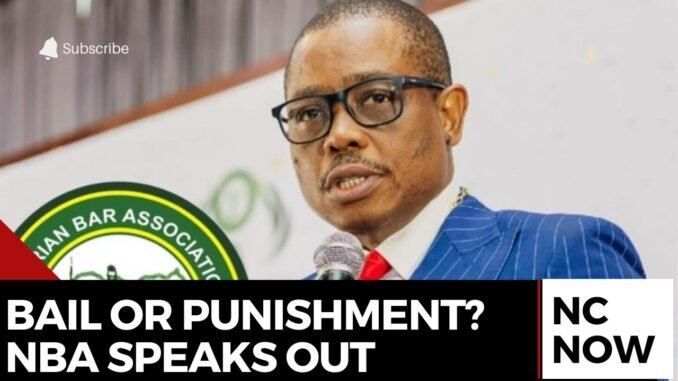

Summary: The Nigerian Bar Association criticizes courts and law enforcement for imposing unrealistic bail conditions that undermine constitutional rights and justice in Nigeria.
The Nigerian Bar Association (NBA) has raised serious concerns over what it describes as an alarming trend of excessive and unrealistic bail conditions being imposed by Nigerian courts and law enforcement agencies.
The professional body of lawyers across Nigeria is speaking out against bail terms that effectively deny citizens their constitutional right to liberty, particularly when courts demand sureties such as senior civil servants or owners of expensive properties in choice locations.
The Growing Crisis in Nigeria’s Bail System
In recent times, many Nigerians who have been granted bail by courts have found themselves unable to meet the stringent conditions attached. The NBA argues that this practice defeats the entire purpose of bail and essentially turns the constitutional right into a privilege for the wealthy and well-connected.
According to the association, courts are increasingly setting bail conditions that include:
– Requiring sureties who are directors or senior civil servants from Grade Level 14 and above
– Demanding property owners with titles in high-value areas like Abuja’s Maitama, Asokoro, or Lagos’s Ikoyi and Victoria Island
– Setting bail amounts that run into millions of naira without consideration of the accused person’s financial capacity
– Requiring multiple sureties with unrealistic qualifications
Constitutional Rights Under Threat
The NBA emphasized that the Nigerian Constitution guarantees every citizen the presumption of innocence until proven guilty. Bail is meant to ensure that an accused person appears for trial, not to punish them before conviction.
“When bail conditions are so excessive that ordinary Nigerians cannot meet them, it becomes a denial of justice,” the association stated. “The essence of bail is defeated when someone granted bail remains in detention because they cannot produce a permanent secretary or a property owner in Banana Island.”
Impact on Ordinary Nigerians
This practice has particularly harsh consequences for average Nigerians who lack connections in high places. Many who are accused of minor offences end up spending months or even years in detention simply because they cannot meet bail conditions, even though they have been granted bail by the court.
Legal practitioners across Nigeria have shared stories of clients who secured bail only to remain in custody because they could not find a Director in the civil service willing to stand surety, or because they didn’t know anyone who owned property in the exclusive areas specified by the court.
Call for Judicial Restraint
The NBA is calling on Nigerian judges and magistrates to exercise restraint and reasonableness when setting bail conditions. The association urged judicial officers to:
– Consider the nature of the offence and the circumstances of the accused
– Set bail conditions that are proportionate and achievable
– Remember that bail is a right, not a privilege
– Focus on conditions that ensure the accused appears for trial, not conditions that amount to punishment
The legal body also reminded courts that excessive bail conditions violate international human rights standards which Nigeria has committed to upholding.
Law Enforcement’s Role
Beyond the courts, the NBA also criticized law enforcement agencies for sometimes recommending unrealistic bail terms in their applications to courts. The association urged police prosecutors and other law enforcement officials to be more reasonable in their bail opposition arguments.
What This Means for Justice in Nigeria
As Nigeria continues to grapple with challenges in its criminal justice system, including congested prisons and delayed trials, the issue of excessive bail conditions adds another layer of concern. When bail becomes inaccessible to ordinary citizens, it undermines public confidence in the justice system and creates a perception that justice is only for the privileged.
The NBA’s intervention comes at a critical time when many Nigerians are calling for reforms in the country’s criminal justice administration. With Nigeria’s prisons already overcrowded, partly due to the high number of awaiting-trial inmates, making bail more accessible could help address this crisis.
The Way Forward
Legal experts believe that addressing this issue requires a multi-pronged approach. Judges need regular training on human rights-compliant bail practices, while there should be clearer guidelines on setting appropriate bail conditions.
Additionally, the NBA suggested that judicial monitoring bodies should review cases where excessive bail conditions are set and provide feedback to the affected courts.
As Nigeria works toward building a more just and equitable society, ensuring that constitutional rights like reasonable bail are accessible to all citizens, regardless of their social status or economic power, remains crucial. The NBA’s stance represents an important step in advocating for reforms that will make Nigeria’s justice system work better for everyone, not just the wealthy and well-connected.
Stay tuned on buzzUp9ja for more updates
Be the first to comment