
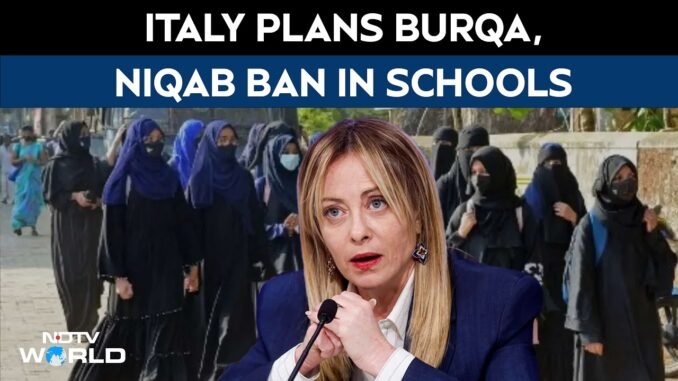

Summary: Italian Prime Minister Giorgia Meloni has announced plans to ban face coverings in schools and cap the number of foreign students per class — here’s what you need to know.
Italy is making moves that are already stirring serious conversation across the globe. Prime Minister Giorgia Meloni announced on Sunday, September 20, at a youth event, that her government is preparing to ban face coverings such as niqabs and burqas in schools*, while also planning to *limit the number of foreign students allowed per classroom.
For many Nigerians who have family members, friends, or even personal aspirations of studying or living in Europe, this kind of policy shift is worth paying close attention to.
What Exactly Did Meloni Say?
Speaking at what was described as a youth-focused gathering, the Italian Prime Minister made clear that these measures are part of her government’s broader agenda around national identity, integration, and education standards. The proposed policy would:
– Prohibit students from wearing face-covering veils — including the niqab and burqa — within school premises
– Set a maximum limit on the percentage of foreign students that can be enrolled in any single class
While full legislative details are still being worked out, the announcement signals a significant policy direction for Italy under Meloni’s right-wing government.
Why This Matters to Nigerians
Nigeria is home to one of the largest Muslim populations in Africa, and the niqab and burqa — though not universally worn — hold deep religious significance for many Nigerian Muslim women and families. Any policy that restricts Islamic dress in educational settings naturally raises eyebrows here at home.
Beyond religious concerns, thousands of Nigerians study and reside in Italy. From students chasing degrees in Italian universities to families who have built lives across Europe, this policy could affect how comfortable and welcomed Nigerians — particularly Nigerian Muslims — feel in Italian institutions.
The cap on foreign students per class also raises questions about equal access to education, a conversation that resonates deeply in a country like Nigeria where access to quality education remains a major talking point.
Not the First of Its Kind
Italy is not blazing an entirely new trail here. Countries like France have long maintained strict rules on religious symbols in public schools, including bans on headscarves. Belgium and parts of Switzerland have also implemented face-covering bans in public spaces.
However, critics argue that such policies often disproportionately target Muslim women and minority communities, raising serious concerns about discrimination and religious freedom.
The Bigger Picture
Meloni’s government, which came to power in October 2022, has consistently pushed for stricter immigration controls and stronger emphasis on Italian cultural identity. These latest proposals fit neatly into that narrative.
For Nigerians watching from afar — whether you have a child studying in Milan, a relative in Rome, or simply care about global affairs — this is a reminder that the world’s policies on identity, religion, and belonging are constantly shifting.
As Nigeria continues to send some of its brightest minds abroad in search of better opportunities, it becomes increasingly important to stay informed about the environments they are entering.
Stay informed. Stay prepared. The world is always changing — and so are the rules.
Tap in for more on buzzUp9ja
Be the first to comment