
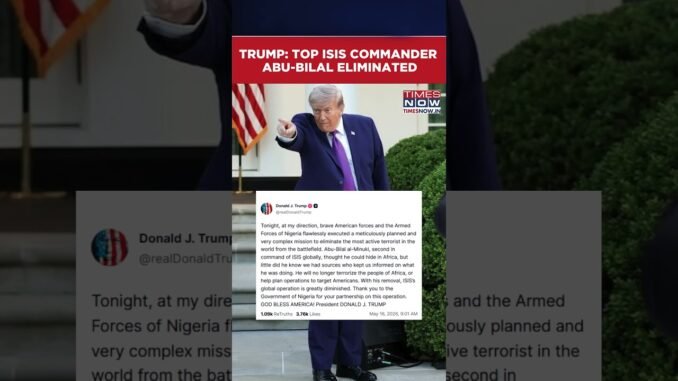

Summary: ISWAP has officially confirmed the death of its high-ranking Nigerian commander Abu-Bilal al-Mainuki in a US military operation, marking a significant development in the fight against terrorism in West Africa.
The Islamic State West Africa Province (ISWAP) has officially acknowledged the death of one of its top commanders, Abu-Bilal al-Mainuki, a Nigerian-born terrorist leader who was killed in a recent military operation allegedly executed by United States forces.
Major Blow to ISWAP Operations
The confirmation of al-Mainuki’s death represents a significant victory in the ongoing battle against terrorism in the Lake Chad region and northeastern Nigeria. The terrorist group, which has terrorized communities across Borno, Yobe, and Adamawa states for years, announced the loss of its senior commander through its propaganda channels.
Abu-Bilal al-Mainuki, whose real Nigerian identity has not been publicly disclosed, had risen through the ranks of ISWAP to become one of its most influential leaders. His elimination is expected to disrupt the group’s command structure and operational capabilities in the region.
The Growing International Response
The reported involvement of US military forces in this operation underscores the international dimension of Nigeria’s security challenges. For years, the United States has provided intelligence, training, and logistical support to Nigerian forces battling insurgency in the Northeast.
This strike demonstrates the continued commitment of international partners to supporting Nigeria’s fight against terrorism, particularly as ISWAP has evolved into one of the most dangerous terror organizations operating in West Africa.
ISWAP’s Reign of Terror in Nigeria
Since breaking away from Boko Haram in 2016, ISWAP has established itself as the dominant terrorist faction in northeastern Nigeria. The group has been responsible for:
– Numerous attacks on military installations and personnel
– Kidnappings of civilians, including schoolchildren
– Destruction of entire communities
– Targeted killings of aid workers and government officials
– Displacement of millions of Nigerians from their ancestral homes
The death of a high-ranking commander like al-Mainuki could potentially weaken the group’s ability to coordinate complex operations, at least temporarily.
What This Means for Nigerian Security
Security analysts suggest that while the elimination of senior terrorist leaders is always significant, it rarely marks the end of the threat. ISWAP has demonstrated resilience over the years, often replacing fallen commanders with equally committed operatives.
However, each successful operation against the group’s leadership creates opportunities for Nigerian and allied forces to:
1. Gather valuable intelligence from the operation’s aftermath
2. Exploit leadership vacuums before succession is established
3. Demoralize rank-and-file fighters who may question the group’s invincibility
4. Disrupt operational planning and ongoing attack preparations
The Road Ahead
Despite this development, residents of northeastern Nigeria continue to face daily threats from ISWAP and other terrorist elements. The Nigerian military, alongside the Civilian Joint Task Force and multinational forces, maintains ongoing operations to degrade the group’s capabilities.
President Bola Tinubu’s administration has pledged to prioritize security in the region, promising enhanced support for military operations and renewed focus on addressing the underlying socioeconomic factors that fuel insurgency.
Regional Implications
The confirmed death of al-Mainuki also has implications beyond Nigeria’s borders. ISWAP operates across the Lake Chad Basin, affecting Chad, Niger, and Cameroon. Regional cooperation through the Multinational Joint Task Force (MNJTF) remains crucial to preventing the group from simply relocating its operations when pressured in one area.
Community Response
For the millions of Nigerians affected by ISWAP’s violence—including internally displaced persons living in camps across Borno, Yobe, and Adamawa—news of the commander’s death may offer a glimmer of hope, though many remain cautious about celebrating prematurely.
Local community leaders have consistently called for sustained military pressure on terrorist groups, combined with genuine efforts at rehabilitation and reintegration of former fighters, and substantial investment in rebuilding devastated communities.
As this story continues to develop, Nigerians will be watching closely to see whether this tactical victory translates into tangible improvements in security and the eventual return of peace to the long-suffering Northeast region.
The fight against terrorism requires not just military solutions but comprehensive approaches addressing poverty, unemployment, lack of education, and other vulnerabilities that extremist groups exploit to recruit and radicalize young Nigerians.
Stay tuned for more details on buzzUp9ja
Be the first to comment