
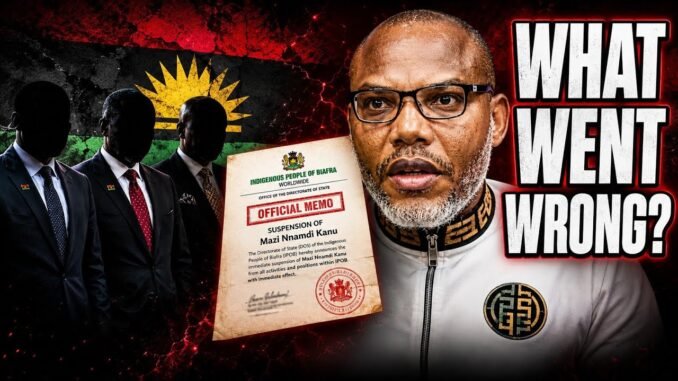

In a stunning development that has sent shockwaves across the Southeast and beyond, the Indigenous People of Biafra (IPOB) has announced the indefinite suspension of Nnamdi Kanu from his position as leader of the organization. The suspension also extends to his role as Director of Radio Biafra.
This unprecedented move marks a dramatic turning point in the separatist movement that has dominated headlines and sparked intense debates across Nigeria for years.
A Leadership Shake-Up That Changes Everything
The announcement, which came through official IPOB channels, represents the most significant internal restructuring the organization has witnessed since its formation. Nnamdi Kanu, the British-Nigerian activist whose fiery rhetoric and unwavering stance on Biafran independence made him a household name, now finds himself on the outside looking in.
For many Nigerians, particularly those in the Southeast, this news raises critical questions: What led to this decision? Who will fill the leadership vacuum? And what does this mean for the future of the Biafran agitation?
The Man Behind the Movement
Nnamdi Kanu rose to prominence as the face of modern Biafran separatism, using Radio Biafra as his platform to reach millions of supporters. His broadcasts, often controversial and uncompromising, galvanized a generation of young Igbos who felt marginalized in the Nigerian political landscape.
His detention by Nigerian authorities, dramatic escape from the country, and subsequent re-arrest in Kenya before being brought back to face trial only elevated his profile further. To his supporters, he became a symbol of resistance; to his critics, a dangerous agitator threatening national unity.
What This Means for IPOB and the Southeast
The suspension creates uncertainty about the direction of IPOB and its activities across the Southeast. The organization has been behind numerous sit-at-home orders that have significantly impacted economic activities in the region, drawing both support and criticism from residents who bear the consequences.
Business owners, transporters, and ordinary citizens in states like Anambra, Imo, Abia, Enugu, and Ebonyi have all felt the effects of IPOB’s influence. This leadership change could signal a shift in strategy or priorities.
National Implications
Beyond the Southeast, this development has implications for Nigeria’s broader security and political landscape. The Federal Government has long viewed IPOB as a security threat, and the group’s activities have been a source of tension between Abuja and the Southeast region.
Will this leadership change open new avenues for dialogue? Could it de-escalate tensions or potentially create further fragmentation within the separatist movement? These questions remain unanswered as events continue to unfold.
What Happens Next?
As Nigerians await further details about this suspension and its implications, several scenarios present themselves:
– Will IPOB announce new leadership immediately?
– How will Kanu’s loyal supporters respond to this decision?
– What impact will this have on his ongoing trial?
– Could this lead to splinter groups or internal conflicts within IPOB?
The Bigger Picture
This development reminds us that even the most seemingly unified movements can experience internal tensions and transformations. It also highlights the complex nature of ethnic nationalism and separatist politics in Nigeria’s diverse democracy.
For now, Nigerians across all regions will be watching closely to see how this story develops and what it means for the peace, security, and unity of our nation.
This is a developing story. Stay tuned for updates as more information becomes available.
Check more details on buzzUp9ja
Be the first to comment