
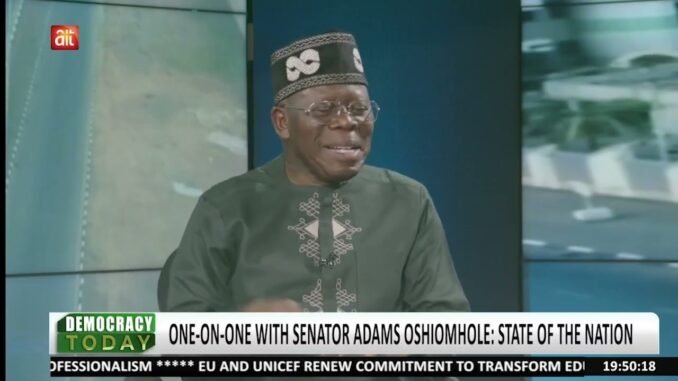

Summary: Former APC National Chairman Adams Oshiomhole reveals how he was removed from office through a Zoom meeting. The Edo Senator shares details of his controversial exit from party leadership.
Former National Chairman of the All Progressives Congress (APC) and current Senator representing Edo North, Adams Oshiomhole, has finally opened up about the circumstances surrounding his controversial removal from the party’s top position.
In a recent interview on African Independent Television (AIT), the outspoken politician made a startling revelation that has set tongues wagging across Nigeria’s political landscape: he was removed from his position as APC National Chairman through a virtual Zoom meeting.
The Virtual Sack That Shocked Nigeria
Oshiomhole’s disclosure sheds fresh light on one of the most dramatic episodes in recent Nigerian political history. The former labour leader, known for his no-nonsense approach and fiery rhetoric, described how modern technology was used to execute his political removal during what many political analysts consider a turbulent period for the ruling party.
The revelation is particularly significant given Oshiomhole’s larger-than-life personality and his historical influence within the APC. As a founding member of the party and former Governor of Edo State, his removal marked a turning point in the internal dynamics of Nigeria’s ruling party.
From Labour Leader to Political Heavyweight
Before his tenure as APC National Chairman, Oshiomhole had built a formidable reputation as a fearless advocate for workers’ rights during his time as President of the Nigeria Labour Congress (NLC). His transition from labour activism to mainstream politics saw him serve two terms as Edo State Governor, where he earned both praise and criticism for his sometimes controversial but often effective governance style.
The Context of His Removal
Oshiomhole’s chairmanship of the APC was marked by internal party crises, allegations of high-handedness, and conflicts over the conduct of party primaries across various states. His leadership style, while decisive, created friction with several party stakeholders, ultimately leading to the circumstances that resulted in his removal.
What This Means for Nigerian Politics
The use of virtual technology for such a significant political decision highlights how Nigerian politics has evolved, particularly during and after the COVID-19 pandemic era. However, it also raises questions about the dignity and process of such important party decisions.
Oshiomhole’s willingness to discuss this chapter of his political career demonstrates his characteristic boldness and transparency, traits that have defined his decades-long career in public service.
As Nigeria continues to navigate its democratic journey, the former chairman’s revelations serve as a reminder of the dynamic and sometimes unpredictable nature of party politics in Africa’s most populous nation.
The Senator’s comments have reignited discussions about internal democracy within political parties and the mechanisms through which party leadership transitions are handled in Nigeria.
Read more political updates on buzzUp9ja
Be the first to comment