
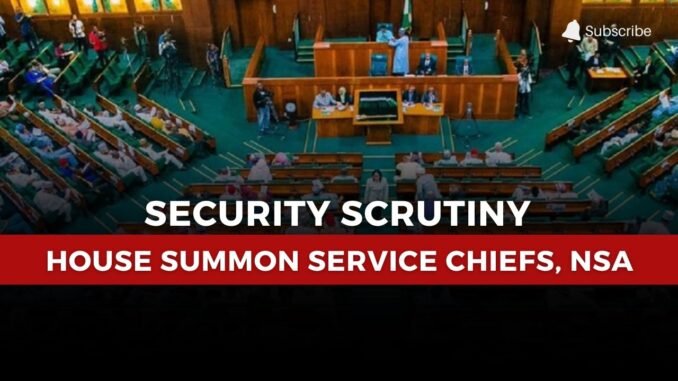

Summary: Nigerian House of Representatives calls emergency meeting with defense minister, service chiefs, and IGP to address the escalating security challenges threatening citizens nationwide.
The Nigerian House of Representatives has taken decisive action in response to the alarming deterioration of security across the country, passing a resolution to summon top military and security officials for urgent consultations.
Among those summoned are the Minister of Defence, Christopher Musa, all service chiefs, the Inspector General of Police (IGP), Kayode Egbetokun, and the Director-General of the Department of State Services (DSS).
A Nation Under Siege
This parliamentary intervention comes at a critical time when Nigerians are grappling with unprecedented security challenges. From the Northeast where Boko Haram and ISWAP militants continue their reign of terror, to the Northwest plagued by banditry and mass kidnappings, and the Southeast dealing with separatist tensions – no region has been spared.
The Middle Belt and parts of the North-Central continue to experience deadly clashes between farmers and herders, while oil-rich communities in the South-South battle pipeline vandalism and sea piracy. Even the relatively peaceful Southwest has witnessed a surge in kidnapping incidents along major highways.
Lawmakers Take Charge
The decision by the House of Representatives reflects growing frustration among Nigerian lawmakers and their constituents who have watched helplessly as security situations worsen despite billions of naira allocated to defense and security agencies.
Members of the House have expressed deep concern over the inability of security forces to decisively tackle the multi-headed hydra of insecurity that has made travel dangerous, disrupted farming activities, and created a climate of fear across the nation.
What Nigerians Expect
Citizens across the country are watching keenly, hoping this summons will translate into concrete action rather than the usual rhetoric. Many Nigerians have lost confidence in government’s ability to protect lives and property – a fundamental constitutional responsibility.
Questions on everyone’s lips include:
– Why have security forces struggled despite increased budgetary allocations?
– What new strategies will be deployed to tackle the various security challenges?
– How will the government address the sophisticated weaponry in the hands of criminals?
– What timeline can Nigerians expect for visible improvements?
The Road Ahead
As the summoned officials prepare to appear before the House, Nigerians remain hopeful but cautious. Previous legislative interventions have yielded limited results, with security briefings often ending in promises that fail to materialize into tangible improvements on ground.
The coming days will reveal whether this intervention marks a turning point in Nigeria’s fight against insecurity or becomes another exercise in political theater. What remains certain is that ordinary Nigerians – farmers afraid to go to their farms, travelers dreading highway journeys, and parents worried about their children’s safety – desperately need solutions, not excuses.
The ball is now firmly in the court of the security chiefs. Nigerians are waiting, watching, and praying for the dawn of safer days.
Discover more on buzzUp9ja
Be the first to comment