
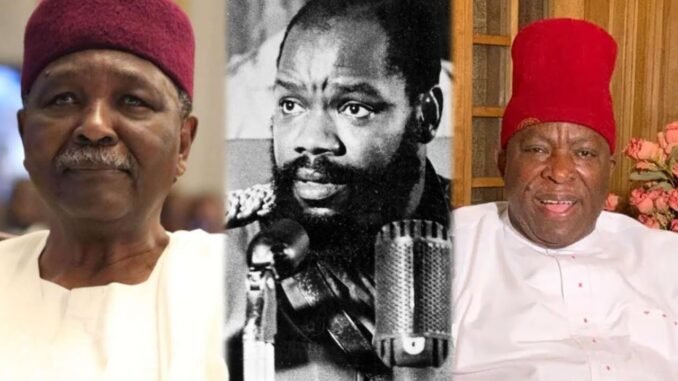

Summary: Former Enugu lawmaker Denge Onoh demands General Yakubu Gowon apologize to Igbo people for Civil War atrocities, sparking fresh debate on Nigeria’s unhealed wounds.
The wounds of the Nigerian Civil War, fought over five decades ago, continue to fester as political voices demand accountability and reconciliation. Former Enugu State House of Assembly member and erstwhile South-East spokesman for President Bola Tinubu, Denge Onoh, has fired a strong salvo at former Head of State General Yakubu Gowon, insisting he owes the Igbo people a heartfelt apology for the immense suffering they endured during the war.
The Call for Accountability
Onoh’s criticism stems from recent remarks made by General Gowon regarding civilian casualties during the 1967-1970 Biafran War. According to Onoh, Gowon’s comments failed to acknowledge the deep trauma and devastation experienced by the Igbo community, particularly the policies and military actions that resulted in widespread starvation, displacement, and death.
“The Igbo people suffered immensely during that war,” Onoh stated emphatically. “Families were torn apart, children starved to death, and entire communities were destroyed. General Gowon, as the leader during that period, bears a responsibility to acknowledge this pain and offer a sincere apology.”
Nigeria’s Unhealed War Wounds
The Nigerian Civil War remains one of the most painful chapters in the nation’s history. The conflict, which arose from attempts by the South-Eastern region to secede and form the Republic of Biafra, claimed an estimated one to three million lives, many of them civilians who died from starvation due to the economic blockade.
For many Igbo people and their descendants, the war’s aftermath brought additional wounds—marginalization, the controversial “abandoned property” policies, and the psychological trauma that has been passed down through generations. Despite Nigeria’s official “No Victor, No Vanquished” stance, many in the South-East argue that true reconciliation has never occurred.
Why This Matters Now
Onoh’s call for an apology is not occurring in isolation. In recent years, there has been growing agitation in the South-East for recognition, inclusion, and justice. From renewed calls for Biafra by groups like IPOB to demands for presidential candidates of Igbo extraction, the region continues to seek acknowledgment of its place in Nigeria’s past and future.
“An apology would be a step toward healing,” Onoh explained. “It would show that Nigeria is ready to confront its past honestly and build a future where all ethnic groups feel valued and respected.”
Gowon’s Legacy Under Scrutiny
General Yakubu Gowon, now in his late 80s, is often credited with keeping Nigeria united during one of its most turbulent periods. However, his legacy remains contested, particularly in the South-East where memories of the war’s brutality remain vivid.
While Gowon has, in various forums, spoken about reconciliation and the need for unity, critics like Onoh argue that words alone are insufficient without acknowledgment of specific wrongs and genuine remorse.
The Road to True Reconciliation
For Nigeria to move forward as a truly united nation, many believe that confronting uncomfortable truths about the Civil War is essential. This includes:
– Official acknowledgment of atrocities committed during the conflict
– Genuine dialogue between all parties involved in the war
– Compensation and development initiatives for war-affected communities
– Educational reforms that teach the war’s history honestly and comprehensively
Onoh’s demand for an apology from Gowon represents more than just a political statement—it is a cry for justice, recognition, and the kind of healing that only comes when truth is spoken and acknowledged.
What Nigerians Are Saying
The call for an apology has generated mixed reactions across Nigeria. While many in the South-East have expressed support for Onoh’s position, some Nigerians argue that reopening old wounds could be counterproductive to national unity.
However, supporters of Onoh’s stance insist that true unity cannot be built on a foundation of unaddressed grievances and unspoken pain.
Conclusion
As Nigeria continues to grapple with ethnic tensions, regional disparities, and questions of justice, Denge Onoh’s call for General Gowon to apologize to the Igbo people serves as a reminder that the past is never truly past until it is properly addressed.
Whether or not this apology materializes, the conversation itself is valuable—forcing Nigerians to confront difficult questions about accountability, reconciliation, and what it truly means to be “one Nigeria.”
The question remains: Is Nigeria ready to have this honest conversation about its history? Only time will tell.
Stay tuned on buzzUp9ja for more stories
Be the first to comment