
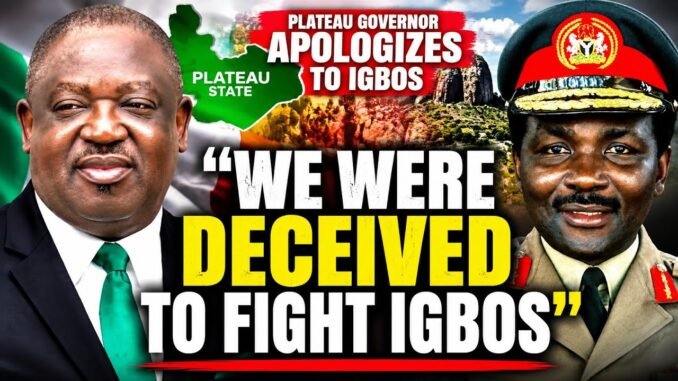

In a bold and emotionally charged move, Plateau State Governor Caleb Mutfwang has opened old wounds — this time, with the intention of healing them.
—
In what many are already calling a historic and courageous gesture, Governor Caleb Mutfwang of Plateau State has publicly apologised to the Igbo people for the role his state played during the Nigerian Civil War (1967–1970). The governor did not mince words, admitting that Plateau people were part of actions that caused suffering to the Igbo community — but stressed that they were “deceived” into their involvement.
A Long Overdue Conversation
The Nigerian Civil War remains one of the most painful chapters in the country’s history. Millions of lives were lost, families were torn apart, and entire communities were shattered. Decades later, the wounds — though quieter — have never fully healed. For many Igbos, the war is not just history; it is a scar carried across generations.
That is what makes Governor Mutfwang’s apology so significant. Rather than allowing the silence to continue, he chose to stand before the Igbo community and say the words that have been long overdue: “I am sorry.”
“We Were Deceived” — Mutfwang’s Position
The governor was candid in his remarks, acknowledging that the people of Plateau State were manipulated into playing a role they perhaps did not fully understand at the time. By describing their involvement as the result of deception, Mutfwang painted a picture of a people who were, in many ways, also victims of the politics and propaganda that fuelled the war.
This is a nuanced point worth reflecting on. The civil war was not simply a conflict between two sides — it was a deeply complex political crisis driven by elite power struggles, ethnic tensions, and colonial-era fault lines. Ordinary Nigerians on all sides were often caught up in forces far beyond their control.
The Call for Reconciliation
Beyond the apology, Mutfwang used the moment to call for lasting reconciliation between the people of Plateau State and the Igbo community. This is not merely a symbolic gesture — true reconciliation requires acknowledgment, dialogue, and a genuine commitment to building bridges.
Nigeria, as a nation, has never had a formal national reconciliation process following the civil war. There has been no Nigerian equivalent of South Africa’s Truth and Reconciliation Commission. Mutfwang’s apology, therefore, feels like a small but meaningful step in a journey the entire country needs to take.
Why This Matters for Nigeria Today
We live in a time when ethnic and regional tensions in Nigeria continue to simmer. From the Middle Belt to the Southeast, from the Northwest to the Niger Delta, old grievances are frequently exploited by politicians for selfish gain. In such a climate, a governor choosing unity over division, healing over hostility, is genuinely refreshing.
The Igbo people have long expressed feelings of marginalisation within the Nigerian state — feelings that trace their roots directly to how the post-war era was handled. Gestures like Mutfwang’s, while they cannot undo history, contribute to the kind of emotional reparation that communities need to move forward.
Nigerians React
Unsurprisingly, the apology has stirred strong reactions across social media and public discourse. Many Nigerians have praised the governor for his boldness and emotional intelligence. Others have questioned whether words alone are sufficient, arguing that reconciliation must be backed by concrete policies that address inequality and marginalization.
Some have also raised eyebrows at the framing of Plateau people as having been “deceived,” with a few arguing that accountability should not be diluted — even while acknowledging the complexities of war-time circumstances.
The Bigger Picture
Governor Mutfwang’s apology is a reminder that healing Nigeria’s deepest wounds requires honesty — the kind that politicians rarely demonstrate. It takes courage to look at history without flinching, to acknowledge the wrongs of the past even when you personally did not commit them.
Whether this moment sparks a broader national conversation about post-war reconciliation remains to be seen. But one thing is clear: the conversation Nigeria has been avoiding for over fifty years can no longer wait.
—
What do you think about Governor Mutfwang’s apology? Is it enough, or does Nigeria need a more formal reconciliation process? Drop your thoughts in the comments below.
Check for more news on buzzUp9ja
Be the first to comment