
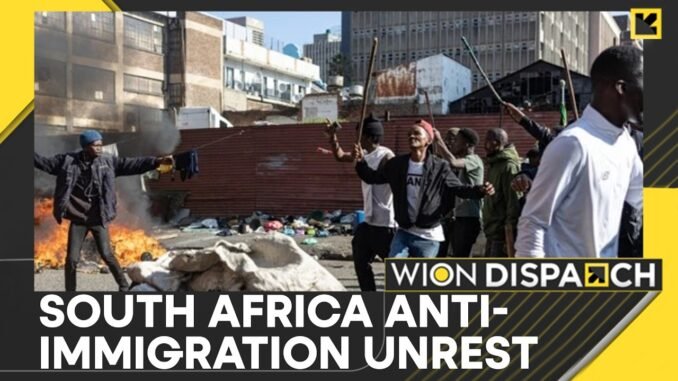

Ghanaian President John Mahama is pushing the African Union to take a bold stand on the rising wave of xenophobic attacks in South Africa — and he says the continent’s dream of unity depends on it.
The issue of xenophobia in South Africa is not new to many Nigerians. Who can forget the harrowing images of Nigerian-owned shops being looted, compatriots fleeing for their lives, and the Nigerian government recalling its ambassador from Pretoria? Those moments cut deep. Now, Ghana’s President John Mahama is doing what many African leaders have been reluctant to do — calling out the problem publicly and demanding that the African Union (AU) sit down and have a serious conversation about it.
Mahama Steps Up Where Others Have Gone Quiet
Mahama has renewed his call for the AU to place the escalating anti-immigrant violence in South Africa firmly on the agenda. This isn’t the first time the Ghanaian leader has raised the alarm, but his persistence signals that the situation on the ground remains deeply troubling.
For Nigerians who have businesses, family members, or friends living in South Africa, this is not a distant political matter — it is deeply personal. Over the years, thousands of Nigerians have built lives in Johannesburg, Cape Town, and Durban, only to find themselves targets of mob violence simply because they are foreigners.
“This Threatens African Unity”
At the heart of Mahama’s argument is a powerful and uncomfortable truth: you cannot preach African integration while allowing Africans to be hunted down in the streets of another African country. The African Union champions the vision of a borderless, united continent — a dream enshrined in frameworks like the African Continental Free Trade Area (AfCFTA). But that dream rings hollow when a Ghanaian trader, a Nigerian entrepreneur, or a Zimbabwean nurse cannot walk safely through certain South African neighbourhoods.
Mahama’s warning is clear — the crisis does not just hurt the victims. It threatens the very soul of Pan-Africanism.
South Africa’s Uncomfortable Reality
South Africa remains one of the continent’s most economically powerful nations, and that magnetism naturally draws migrants from across Africa seeking better opportunities. However, high unemployment and deep inequality within South Africa have, over the years, been weaponised by some to justify violent hostility toward foreign nationals.
Nigerians, Zimbabweans, Mozambicans, Ethiopians, and Somalis have all borne the brunt of these attacks at different times. Shops are burned, people are killed, and communities are uprooted — while the response from South African authorities has often been criticised as too slow and too soft.
Why This Matters Deeply to Nigerians
Nigeria and South Africa have one of the most complex bilateral relationships on the continent — equal parts rivalry, admiration, and tension. When xenophobic violence flares up, it consistently puts that relationship under enormous strain.
Beyond politics, there are real human stakes. Nigerians in the Diaspora — particularly those in South Africa — deserve the protection of both their host government and the backing of continental institutions. Mahama’s push for an AU debate is essentially an argument that the silence of African leaders is itself a form of complicity.
If the AU can convene emergency sessions on coups and border disputes, surely it can find time to address the systematic targeting of African migrants on African soil.
What Should the AU Actually Do?
Critics of Mahama’s call may argue that the AU has little enforcement power, and they would not be entirely wrong. The continental body has historically struggled to translate declarations into action. However, there are meaningful steps that a serious AU engagement could trigger:
– Formal condemnation of xenophobic violence, sending a diplomatic signal to Pretoria
– A dedicated task force to monitor and report on the treatment of migrants across member states
– Bilateral pressure on South Africa to prosecute perpetrators and reform its approach to migration
– A continental dialogue on migration policy that addresses the root causes of anti-immigrant sentiment
The Bigger Picture
Ghana and Nigeria may sometimes compete for the unofficial title of West Africa’s loudest voice, but on this issue, Mahama’s position deserves solidarity from Abuja. Nigeria has more citizens affected by this crisis than perhaps any other West African nation.
As AfCFTA promises to deepen economic integration across the continent, the free movement of people cannot remain an afterthought. A continent where an Igbo businessman or a Fante trader fears for his life in another African country is not a continent that is truly integrating.
Mahama is right to keep pushing. The AU must stop looking away.
What do you think? Should the Nigerian government be doing more to protect Nigerians in South Africa? Drop your thoughts in the comments below.
Stay tuned for more details on buzzUp9ja
Be the first to comment