
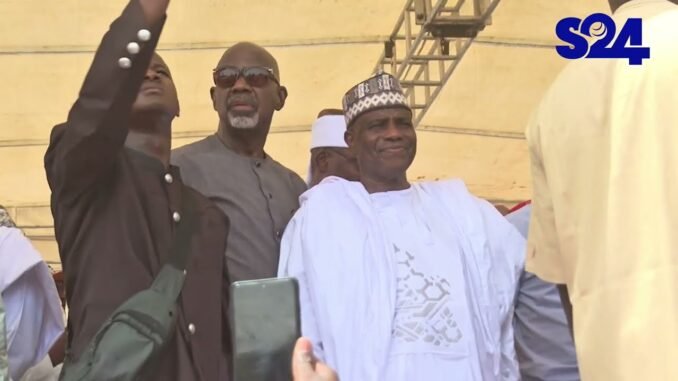

A former loyalist of Kwankwasiyya movement leader Rabiu Musa Kwankwaso has crossed the carpet to join the All Progressives Congress (APC), raising fresh questions about loyalty and political faith in Nigerian politics.
—
In Nigerian politics, where allegiances shift like harmattan dust, yet another dramatic defection has made headlines — and this one comes with a particularly striking backstory.
Kabiru Adamu Abdullahi, a long-standing ally of New Nigeria Peoples Party (NNPP) chieftain and former presidential candidate Rabiu Musa Kwankwaso, has formally dumped the Kwankwasiyya movement to pitch his tent with the ruling All Progressives Congress (APC).
What makes this defection especially eyebrow-raising is the fact that Abdullahi had at some point sworn on the Holy Quran to remain loyal to Kwankwaso and the Kwankwasiyya political movement — a declaration that, in a deeply religious society like northern Nigeria, carries enormous moral and spiritual weight.
Another Carpet-Crosser in the House
If you have been following Nigerian politics for any length of time, you already know that defections are practically a national pastime. Politicians move from party to party the way Lagosians switch lanes on the Third Mainland Bridge — swiftly, boldly, and sometimes without warning.
But swearing on the Quran? That is on a different level entirely. In the North, such an oath is not taken lightly. It is the kind of vow that communities remember, and one that carries consequences far beyond the political arena.
Yet, here we are.
Abdullahi’s move to the APC signals yet another crack in the Kwankwasiyya political structure, which had already been under pressure following Kwankwaso’s underwhelming performance in the 2023 general elections, where he ran as the NNPP’s presidential candidate.
The Kwankwasiyya Movement Under Pressure
The Kwankwasiyya movement, built around the towering political persona of Rabiu Musa Kwankwaso, was once considered one of the most formidable political structures in northern Nigeria. With its signature red caps and fierce loyalists, the movement commanded serious grassroots support, particularly in Kano State.
However, the 2023 elections dealt the movement significant blows. Kwankwaso’s presidential ambition failed to translate into the nationwide momentum his camp had anticipated, and the NNPP’s performance outside Kano was largely underwhelming.
Since then, the movement has been losing key figures — and Abdullahi’s defection is yet another signal that the once-solid structure may be experiencing serious fractures.
What This Means for Nigerian Politics
For ordinary Nigerians watching from the sidelines, this kind of defection reinforces a painful reality: in our political landscape, oaths, loyalty, and ideology are often secondary to personal ambition and access to power.
When a man swears on the Quran — one of the most sacred acts in Islam — and still finds a reason to walk away, it tells you something profound about the transactional nature of Nigerian politics.
It also puts the spotlight back on the APC, which continues to attract politicians from across party lines, consolidating its dominance ahead of future electoral contests.
The Bigger Conversation
This defection is not just about one man or one party. It is a mirror held up to Nigerian political culture — where structure, ideology, and even sacred oaths can dissolve in the heat of political convenience.
As Nigerians, we must begin asking harder questions: What do our politicians truly stand for? And if a man cannot keep a vow made before God, what exactly are we trusting him to protect?
The carpet-crossing continues. And the Nigerian political drama? It is far from over.
—
What do you think about politicians who break sacred oaths for political gain? Drop your thoughts in the comments below.
Follow for more news on buzzUp9ja
Be the first to comment