
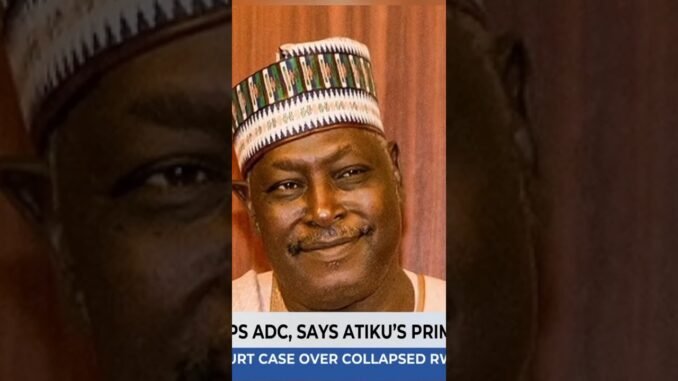

Summary: Babachir Lawal, former SGF under Buhari, has resigned from the African Democratic Congress (ADC), claiming the party’s primaries were rigged in favour of Atiku Abubakar. Read the full details.
In what appears to be another twist in Nigeria’s ever-dramatic political theatre, former Secretary to the Government of the Federation (SGF), Babachir David Lawal, has officially dumped the African Democratic Congress (ADC), citing what he described as “massive rigging” in the party’s recently concluded primaries.
The Resignation That Has Tongues Wagging
Babachir Lawal, who served as SGF under President Muhammadu Buhari before his controversial removal in 2017, has now walked away from the ADC in dramatic fashion. According to the former SGF, the party’s primaries were heavily manipulated to favour former Vice President Atiku Abubakar, making it impossible for him to continue his membership.
This development is particularly significant given Lawal’s political history and his previous vocal opposition to certain political figures and arrangements. The Adamawa-born politician has never been one to shy away from controversy, and this latest move confirms that pattern.
“The Process Was Compromised” – Lawal’s Claims
In his resignation statement, Lawal didn’t mince words about his reasons for leaving the ADC. He alleged that the party’s leadership allowed the primaries to be hijacked, creating an uneven playing field that favoured Atiku Abubakar’s emergence as the party’s flagbearer.
For those familiar with Nigerian politics, allegations of rigged primaries are nothing new. From Lagos to Sokoto, Enugu to Borno, stories of manipulated delegate lists, monetized conventions, and predetermined outcomes have become almost synonymous with the Nigerian political process. However, when someone of Lawal’s stature makes such claims publicly, it carries additional weight.
What This Means for Nigerian Politics
Babachir Lawal’s exit from ADC raises several important questions about the state of opposition politics in Nigeria:
The Search for a Political Home: Since his fallout with the APC and the Buhari administration, Lawal has been searching for a political platform that aligns with his ambitions. His brief stint with ADC and subsequent resignation suggests that many Nigerian politicians are still struggling to find credible alternatives to the dominant parties.
Internal Democracy Deficit: The allegations of rigged primaries once again highlight the chronic problem of internal democracy within Nigerian political parties. Whether APC, PDP, ADC, or any other alphabet soup party, the selection process often favours power brokers over genuine democratic principles.
The Atiku Factor: That these allegations centre around Atiku Abubakar is also noteworthy. The former Vice President has been a permanent fixture in Nigerian presidential politics since 1993, and his involvement in any party automatically changes its dynamics—for better or worse.
A Pattern of Political Musical Chairs
To properly understand this development, we must remember that party-hopping is practically a national sport among Nigerian politicians. Lawal himself has moved between political platforms based on convenience and opportunity, much like many of his contemporaries.
What makes this situation slightly different is the public nature of his grievances and the specific allegations made. Rather than quietly fading into another party, Lawal has chosen to make noise—perhaps to position himself for negotiations with other political actors or to maintain relevance in the public consciousness.
What Babachir Lawal Has Said About Political Alliances
Over the years, particularly after his removal as SGF over the controversial grass-cutting scandal, Lawal has been quite vocal about northern politics and the need for certain political alliances. He was notably opposed to a Muslim-Muslim ticket and became one of the leading voices in northern Christian political advocacy.
His involvement with ADC appeared to be part of a broader strategy to create an alternative platform, possibly for 2027. However, with this resignation, that plan seems to have hit a brick wall.
The Bigger Picture: Nigeria’s Political Landscape
This incident is symptomatic of larger issues within Nigeria’s political ecosystem:
1. Party Loyalty is Transactional: Politicians join and leave parties based on personal interests rather than ideological alignment.
2. Money Politics Reigns Supreme: Allegations of rigged primaries almost always involve claims of financial inducement and delegate manipulation.
3. Leadership Selection is Opaque: Despite constitutional provisions and party guidelines, the actual process of selecting candidates remains murky and controlled by godfathers.
4. Alternative Parties Struggle: The ADC, like many other alternative parties, has failed to distinguish itself from the mainstream parties in terms of internal processes.
What Next for Babachir Lawal?
The million-naira question now is: where does Babachir Lawal go from here?
Will he return to the APC, the party where he once wielded considerable influence? Will he join forces with other disgruntled politicians to form yet another platform? Or will he take time off active politics to strategize for 2027?
Given Nigeria’s political history, we shouldn’t be surprised to see him resurface in an unexpected place, possibly with a new set of political allies and renewed ambitions.
The Atiku Abubakar Angle
As for Atiku Abubakar, this is just another day in the office. The Wazirin Adamawa has weathered countless political storms and emerged relatively unscathed. Whether these allegations affect his standing in ADC or his broader political calculations remains to be seen, but history suggests he’ll navigate this with his characteristic political dexterity.
Final Thoughts
Babachir Lawal’s resignation from ADC and his allegations of rigged primaries provide yet another reminder of how Nigerian politics operates. Behind the rhetoric of democracy and change, the same old patterns persist: big men influencing outcomes, money determining delegates’ choices, and politicians hopping from one party to another in search of personal advantage.
For the average Nigerian watching from the sidelines—perhaps while battling fuel scarcity, unstable electricity, or inflated food prices—these political dramas might seem like entertainment from a disconnected elite. And perhaps that’s exactly what they are.
The question remains: when will Nigerian politicians prioritize building strong, democratic institutions over personal ambitions? When will party primaries be genuinely free and fair? And when will the electorate have real choices rather than recycled faces moving between political platforms?
Until then, we can expect more resignations, more allegations, and more political musical chairs. After all, in Nigerian politics, the show must go on—even if the audience has stopped clapping.
What do you think about Babachir Lawal’s resignation and his allegations? Are Nigerian political parties capable of conducting free and fair primaries? Share your thoughts in the comments section.
Stay tuned on buzzUp9ja for more news
Be the first to comment